
Home
528 Acton Construction
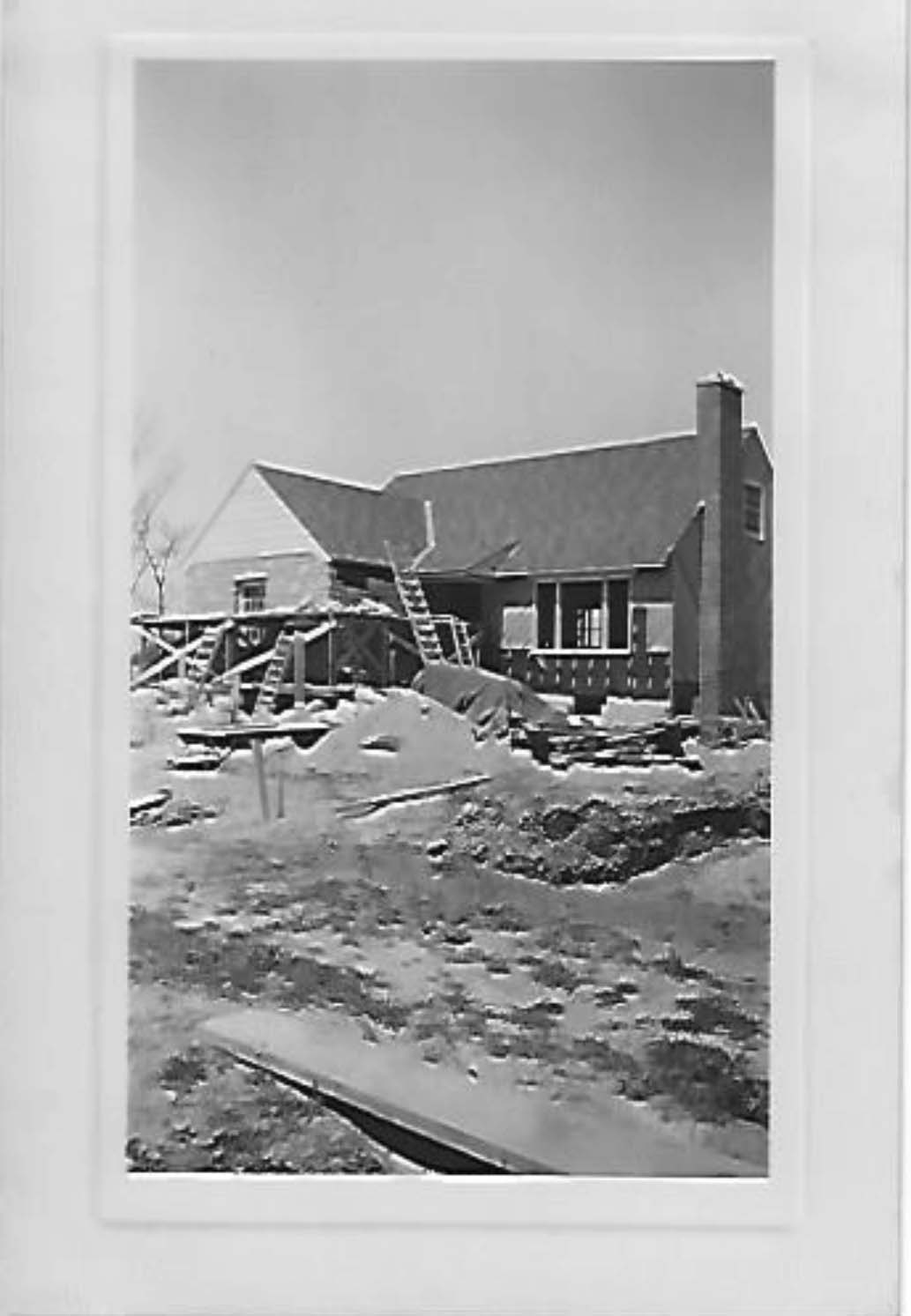
Scott Jones, a professor in the OSU School of Music, kindly shared some terrific photos of the 1947 construction of his house at 528 Acton Road.
The photos came to Scott from Sally Schock (Moore) who grew up in the house and whose father’s brother built the home in 1947.


 The house looks today very much like it did when finished in 1947.
Wilke’s Quality Market (3131 North High)
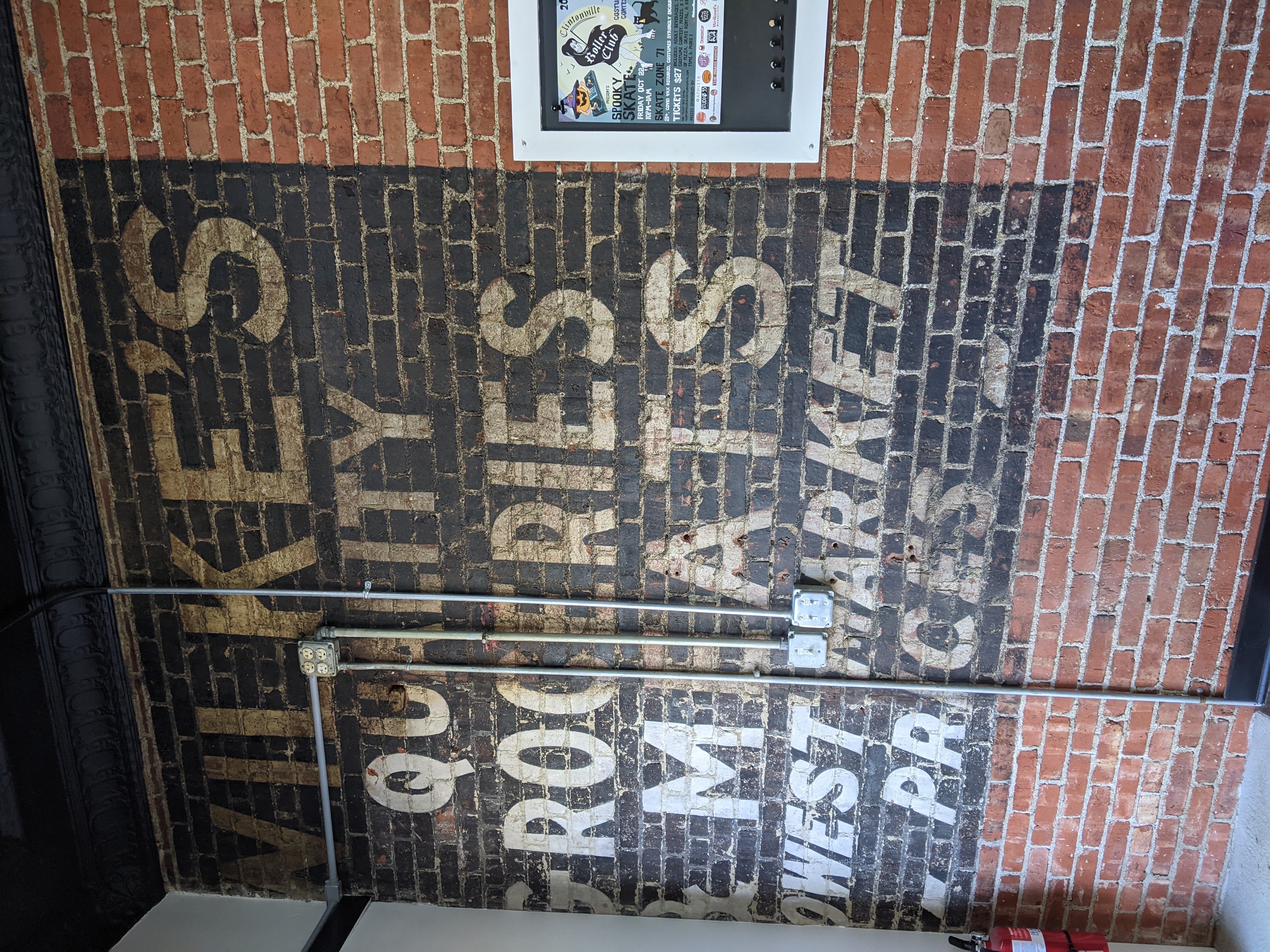 Last month I mentioned the new Clintonville store, Re-Wash, owned by Samantha White. While Sam was renovating the space, she uncovered this wonderful sign from a previous era. It was on the wall–undoubtedly the exterior wall–of 3131 North High (now “Lucky 13 Salon”). In 1926, 3131 North High Street was occupied by Wilke’s Quality Market.
 Here’s an ad from the Columbus Evening Dispatch on April 22, 1926. The Wilke family business–which eventually became Ohio Packing Company–lasted for some 107 years in Columbus. (The Wilke’s Quality Market in Clintonville seems to have been one of the Wilke family’s more minor locations.) The business was established in 1907 by Fritz Wilke as a neighborhood butcher shop in Columbus, eventually focusing on meat cutting and packing. Different aspects of the business were run by various family members–finally by 3rd and 4th generations of the family. Ohio Packing Company closed in April, 2014. There’s a little history of that business here and here though I myself cannot at the moment access the latter article.
In case you are wondering: that other Clintonville market mentioned in the Shredded Wheat ad, Quality Market at 3496 North High Street, was located where Seitan’s Realm is today.
And about that Dispatch ad: Yes, I would LOVE to see them making Shredded Wheat, back in the day; wouldn’t you? You can read more about Henry Perky, the inventor of Shredded Wheat, Triscuits, and the machine that made them, here.
[The ad was provided to me by Loraine of the Columbus Metropolitan Library–Local History and Genealogy Desk; it’s from the Columbus Dispatch published as Columbus Evening Dispatch, April 22, 1926, p14.]3133 North High Street (Re-Wash)
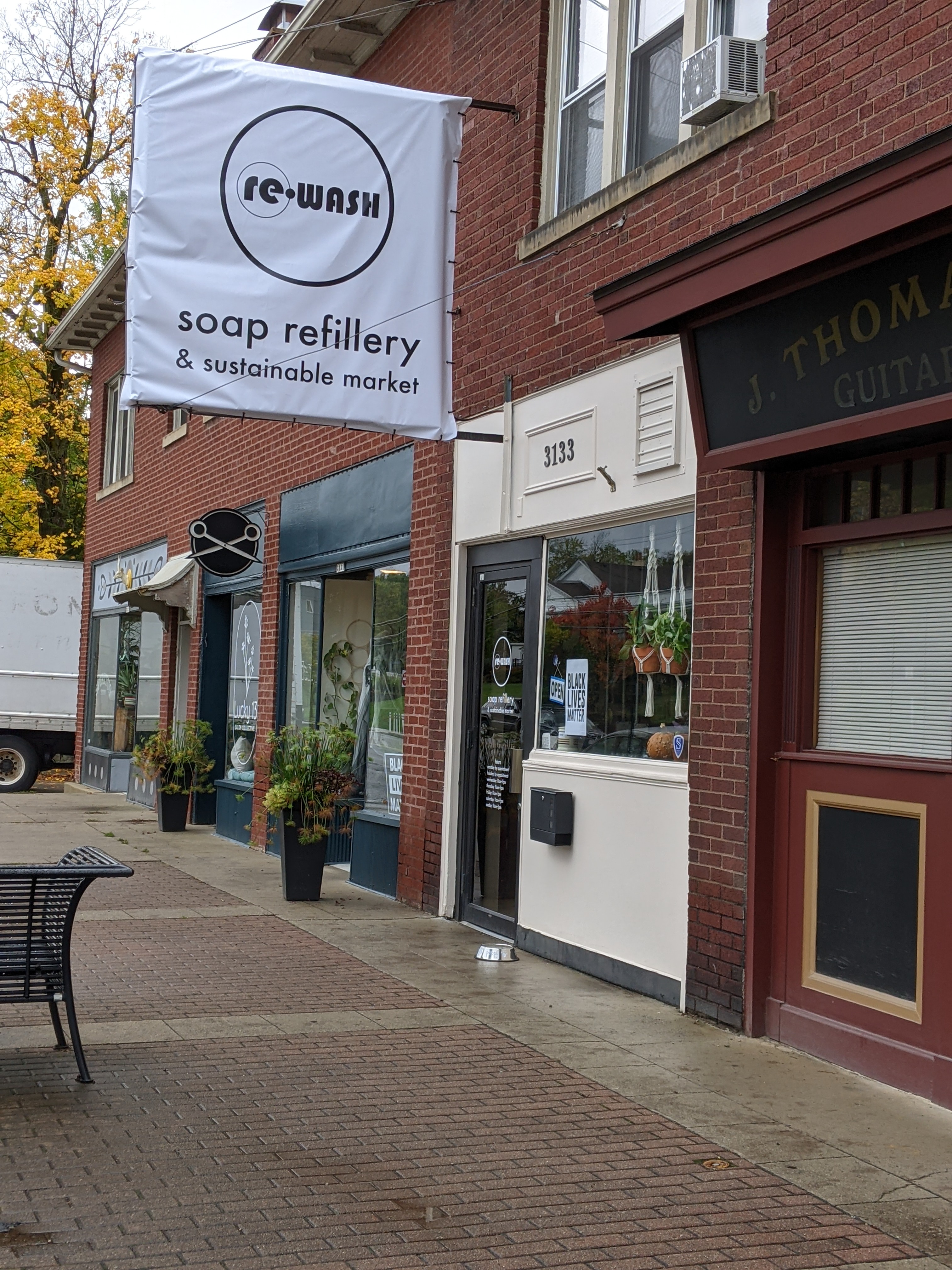 There’s a new kid in town! Re-Wash Refillery has opened in the space formerly occupied by Nancy’s Restaurant at 3133 North High Street. Owner Samantha White has done a stunning job of making “adaptive reuse” of the space and we trust this business will become as much of a Clintonville icon as her predecessor was.
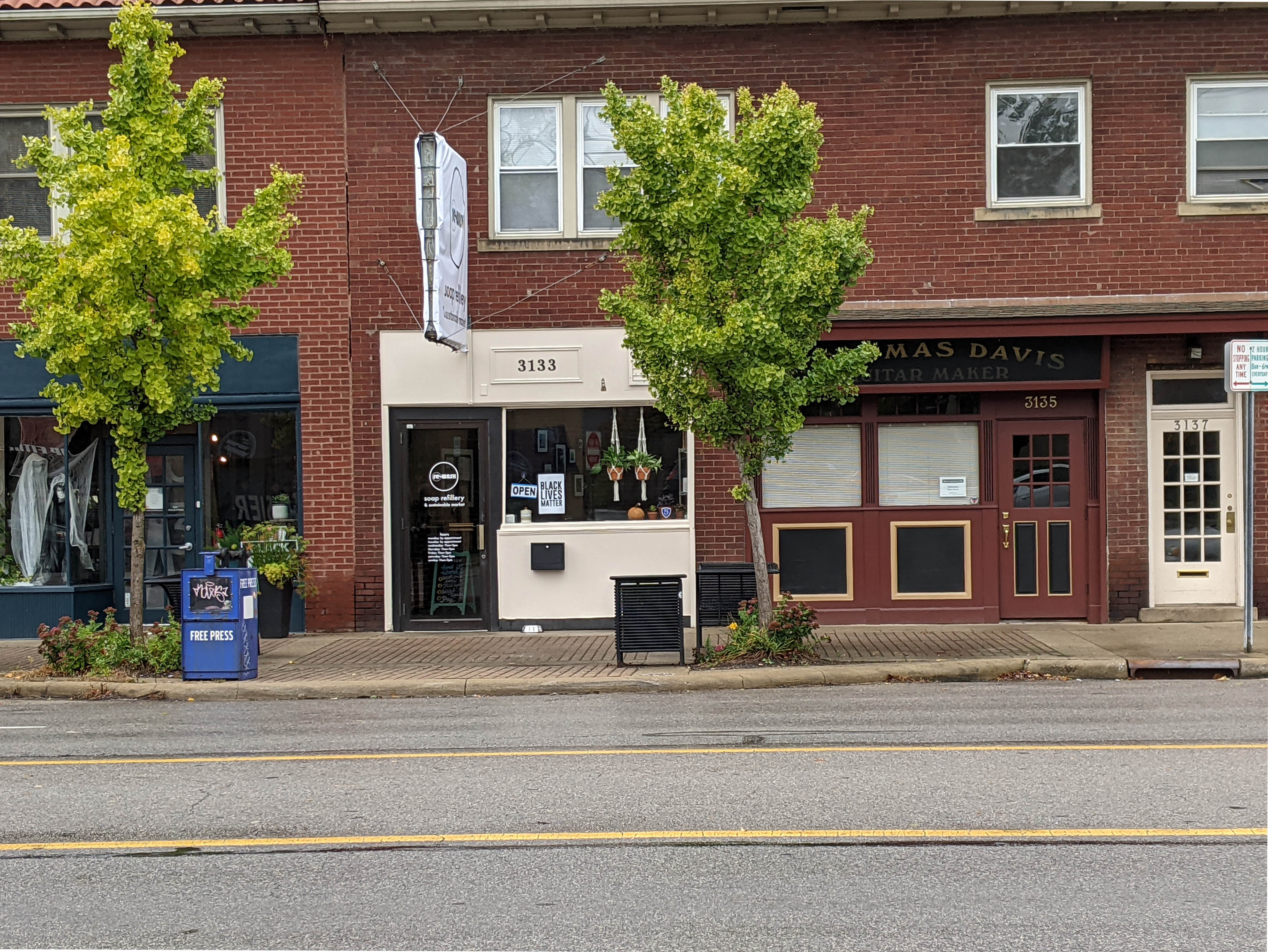 I looked at the history of 3133 North High Street. Here’s what I found.
- Prior to 1929, nothing was listed at that address.
- From 1929 to about 1932, 3133 N High was the Clinton Barber Shop, also variously listed as Clinton Beauty Shop, and F S & GD Port Beauty Shop. Floyd Port Sr and his wife were the managers.
Note: for several years, Hansen’s Bakery—a minor Columbus chain of bakeries—was located next door at 3135 N High, where J. Thomas Davis Guitar Maker is currently located.. It must have been nice to have those bakery smells!
 From 1933-1938, 3133-3135 N High was the Great A & P Tea Company, grocer. (The Great Atlantic & Pacific Tea Company, better known as A&P, was an American chain of grocery stores that operated from 1859 to 2015.) Note the combined address; they took over 3133 as well as Hansen’s Bakery next door. This is a picture of the store’s exterior, from an August 11, 1933 Dispatch page.
There is a Columbus Dispatch Aug 11 1933 newspaper ad for A&P’s opening day at this location. “One package of delicious Sparkle Gelatin Dessert with each 50¢ purchase of groceries or meats on opening days.” Yum Yum!
- From 1939 through 1947, 3133 N High was the Chas Lee Laundry. I found some Dispatch mentions of a Chan Lee Laundry; this may be the same but I am not sure.
- In October 1948 through 1949, 3133 N High was the Warner Appliance Sales and Service Co. An article about the store’s opening from the October 22, 1948 Dispatch is attached.
- 1950—the space was vacant.
- 1951-1955, 3133 N High was the Showboat Inn Restaurant, Gus Deonesos was listed as the manager. (From his obituary: “Gus P. Deonesos, 94, passed away on April 16, 2014. Gus was a United States Army and World War II veteran. He owned 2 restaurants in Columbus, OH before moving to St. Petersburg, FL in 1958.” His family were Greek and he belonged to the Greek Orthodox Church when he lived in Columbus.)
- 1956, it became Ron and Jerry’s Restaurant, Ron Kulwein, manager
- 1957 -1958, the space was Miller’s Restaurant, Walter G & Rosemary Miller, managers.
- 1959-1967, it was Fields Restaurant. Lawrence M. Fields and his wife Minnie lived at 53 Tibet. (Lawrence was listed as the owner from 1959 – 1961; from 1964 Mrs. Minnie Fields was the owner—so Lawrence had probably passed away between 1961 and 1964.)
- 1968 it became Nancy’s Restaurant. It was initially owned by Nancy Kemmerling, until 1971. By 1972, Cindy Moore was listed as the owner of Nancy’s Restaurant (so the sale occurred around 1971). Cindy’s father, Lawrence E. King Sr., was listed as a partner in the restaurant in his 1976 obituary. Cindy lived at 128 Crestview. I didn’t check when she changed her name from Moore to King (she was a widow) but it was after 1976. Cindy closed the restaurant briefly in 2009, then her niece Sheila Davis Hahn reopened it. Sheila died in 2012, and her husband took it over. From a 2006 interview with Cindy: “…I didn’t want to buy a new sign, so I bought Nancy’s name for $100, giving me the rights for 100 years. People call me Nancy all the time. It’s kind of funny.” A Dispatch article about Cindy with photograph is attached, along with another article that includes Cindy’s recipe for her famous meatloaf.

The Hollenback family—the people who started the Booster, lived across the street, and their press office was there as well. So here and here are some pictures taken by the Hollenbacks, of the area, taken from across the street, way before 3133 North High Street was built. See also pages 14, 15, 16, 52 in my book.
Broadway, ever controversial
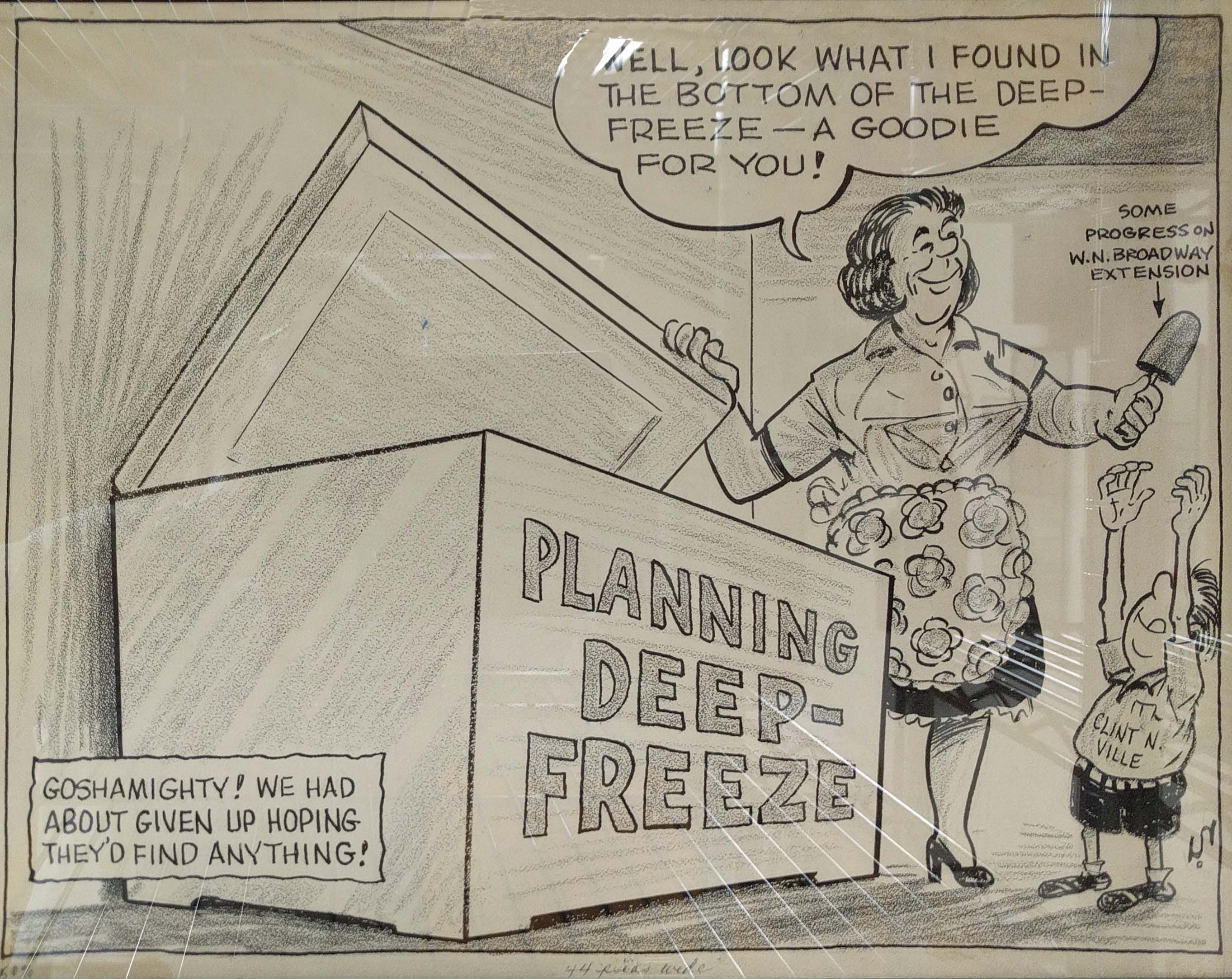 This is a political cartoon from the Clintonville Booster. The “Broadway Extension” involved extending North Broadway from Olentangy River Road westward to Kenny Road. It was a controversial and lightning-hot issue from about 1952 until the planned start of construction in October 1963, and well beyond.
Originally, residents of Upper Arlington objected to the extension, which traversed their city; and then it was realized that the extension would create traffic flow issues on Kenny and Fishinger both of which would need to be widened as a result. And eventually planning of the “Olentangy Freeway” (Rte 315) also entered the mix. It was on again, off again, with Upper Arlington approving then rescinding its approval several times. By the time the project got final approval, the designated federal funding had been tapped for other projects and so the extension was further delayed. I’m not sure what year this cartoon was published. I found an article that construction from Kenny Road to Clearview got underway in June 1966. In December 1968, there was a ribbon cutting ceremony for the extension.
It’s hard for many of us today to imagine North Broadway terminating at Olentangy River Road. Harder even to imagine Clintonville before the North Broadway bridge was built over the river in 1939! (In a nutshell: the bridge over the river was built 1939-40; United States involvement in World War II was 1941 – 1945, bringing most domestic construction to a halt; planning on this Broadway extension project resumes ca. 1952, ending well, I’m not sure when Route 315 was actually finished.)
[Image is from The Booster, and courtesy of the Hollenback Collection at the Clintonville Historical Society. I snapped a picture of the cartoon while it was still in the frame; apologies for the glare.]Gulf Station
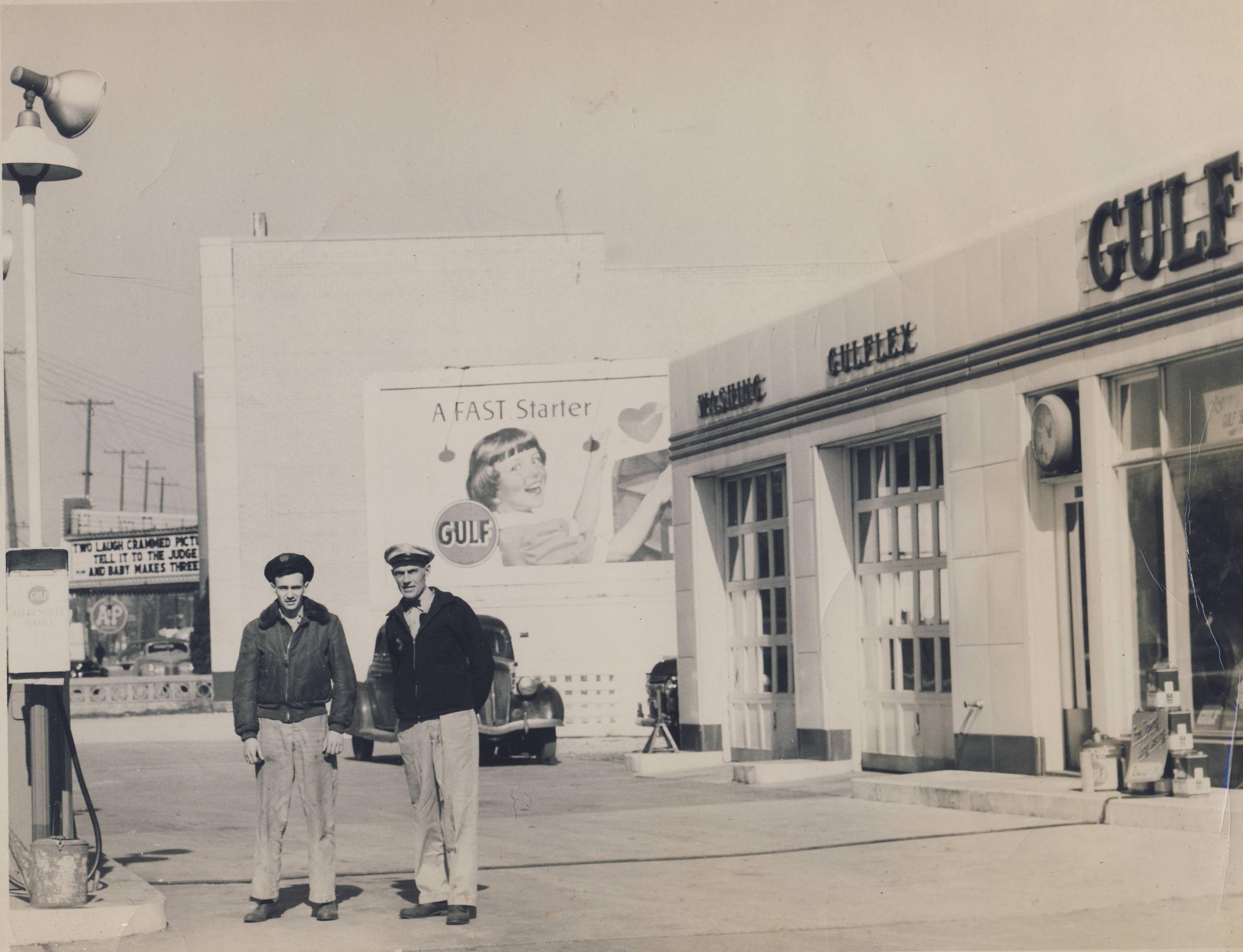 This gas and service station was located at the northeast corner of North High Street and Indian Springs Drive. The old building was renovated to transform it into a Fusian Restaurant. (Thanks to Bob O’Shaughnessy, who informed me that this is Fusion’s preferred method of developing new restaurants.) Can anyone out there name the men?
Note the “two laugh-crammed pictures” at the movie theater in the background.
[Image courtesy of the Hollenback Collection of the Clintonville Historical Society.]Remembering the Rosemary Neighborhood by Knopf & Near
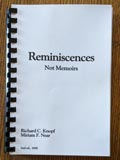
David Penniman, a resident of the Rosemary neighborhood, sleuthed out a copy of a document penned in 1984-88 by Richard C Knopf and Miriam F Near. The document, entitled Reminiscences: Not Memoirs, is a free-wheeling remembrance of growing up in the neighborhood around Henderson and Rosemary Parkway in the 1920s, 1930s, and 1940s. Dave’s copy came from Ann and Keith Bossard of Dominion Blvd; Dave then digitized the 97 page book and shared it with us. Thanks, Dave!
Both Richard and Miriam are deceased; their obituaries are linked below.
Richard C Knopf, 1/4/1925 – 7/17/2002
Miriam Fowle Near, 6/28/1924 – 12/10/2009
I’m so appreciative of people who preserve local history, as Richard and Miriam, and Dave, have done.
[Digital version of the Knopf and Near typescript courtesy of David Penniman. Knopf obituary came courtesy of the Ashtabula Public Library System based on a search and tip from Nick Taggart, retired librarian par excellence at the Columbus Metropolitan Library.]