Home
Researching Your Address
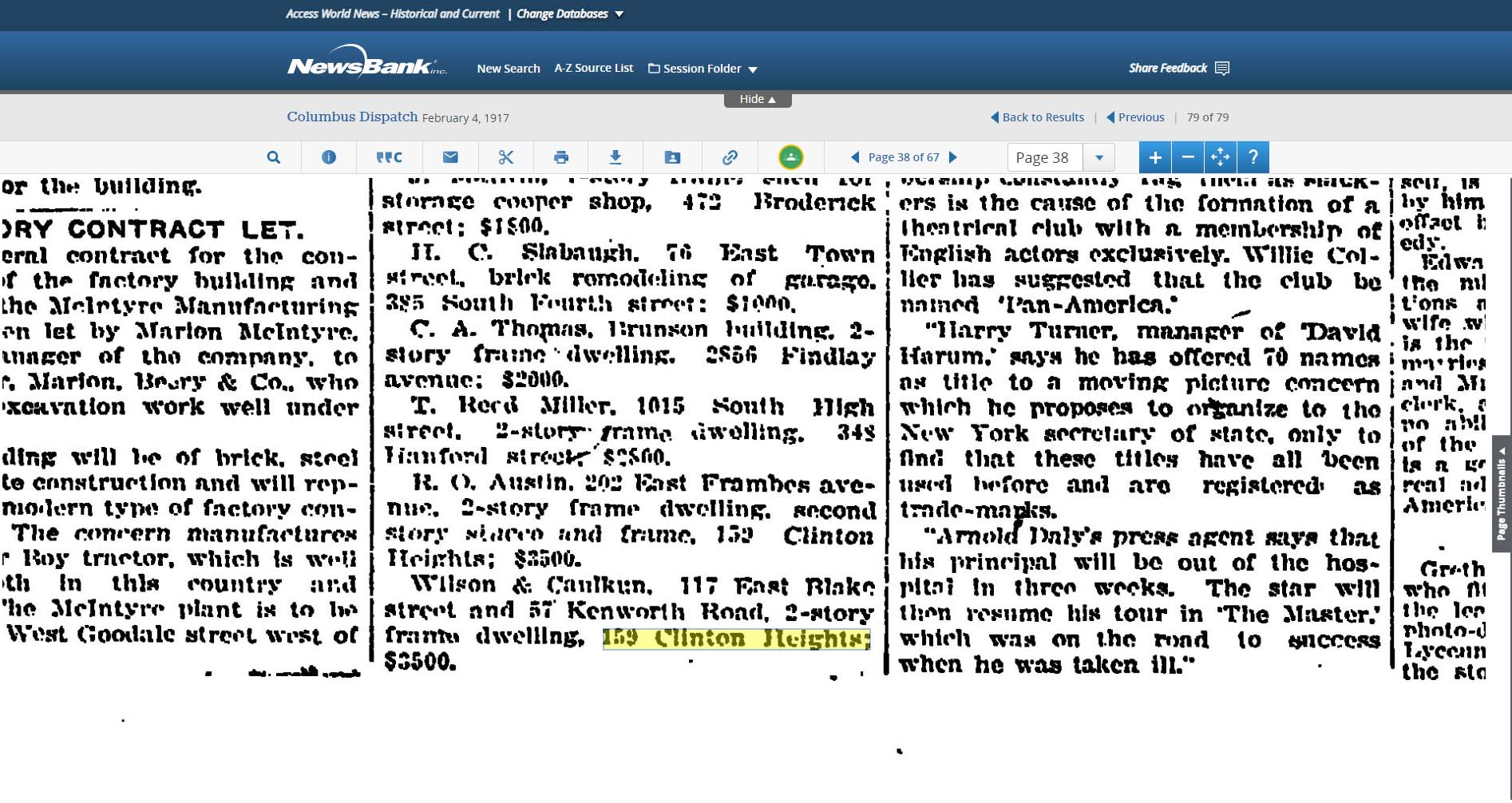 A fun tip for researching your address, from Clintonville Historical Society’s Jeffrey Carter:
–Go to the Columbus Library’s web site.
–Go to Research.
–Find Columbus Dispatch.
–Put in your library card and pin number.
–Enter keyword and search by date. {Shirley suggests: try using your street address in quotes.]
Jeffrey says, “I researched my address and found that during prohibition 3 people were arrested for bootlegging
at 265 Brevoort!”
Lust You Be Tempted…
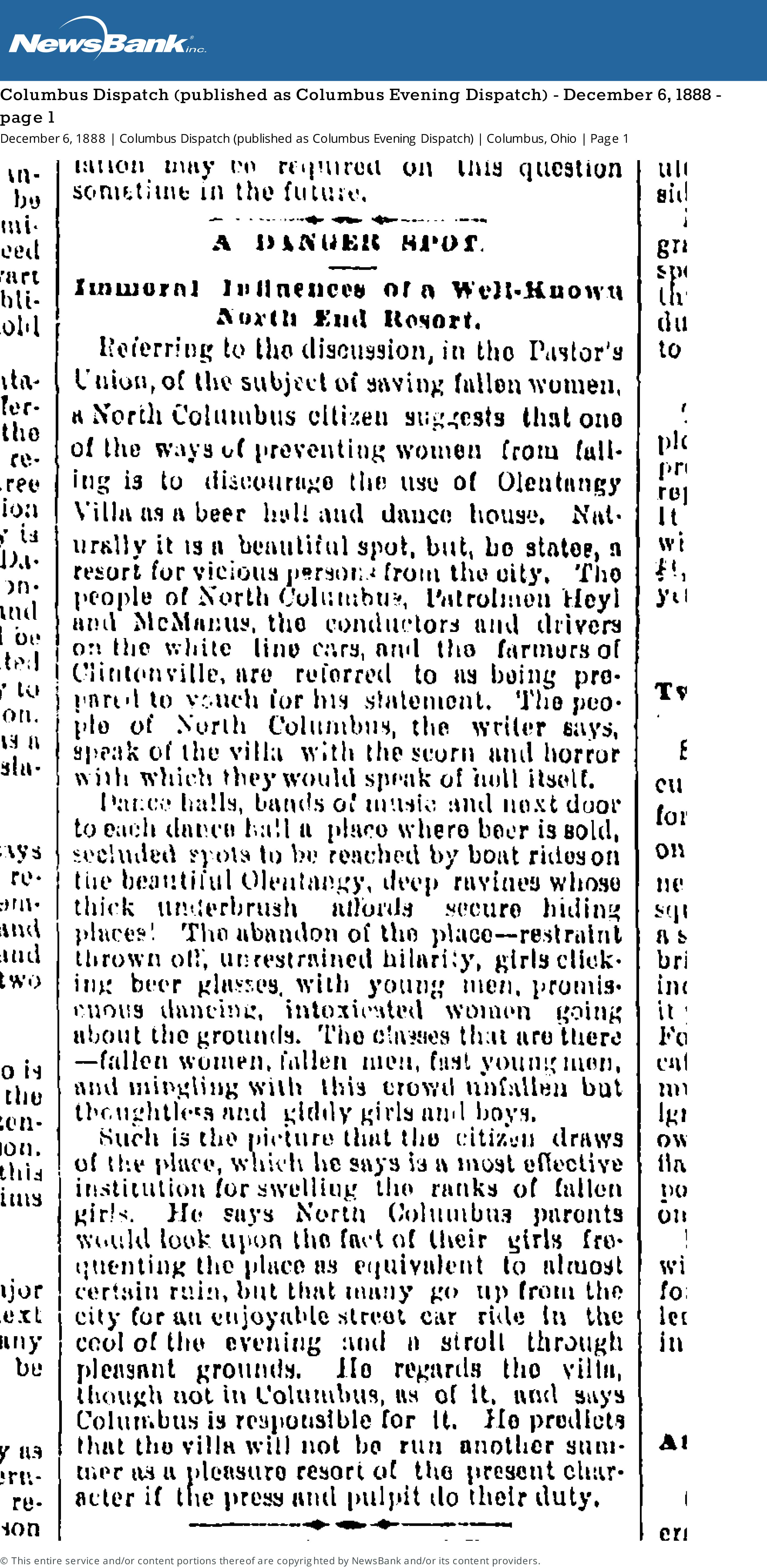
[From the Columbus Dispatch (published as Columbus Evening Dispatch) Thursday December 6, 1888 page 1]A danger Spot
Immoral Influences of a Well-Known North End Resort
Referring to the discussion, in the Pastor’s Union, of the subject of saving women, a North Columbus citizen suggests that one of the ways of preventing women from falling is to discourage the use of Olentangy Villa as a beer hall and dance house. Naturally it is a beautiful spot, but, he states, a resort for vicious persons from the city. The people of North Columbus, Patrolman Heyl and McManus, the conductors and drivers on the white line cars, and the farmers of Clintonville are referred to as being prepared to vouch for his statement. The people of North Columbus, the writer says, speak of the villa with scorn and horror with which they would speak of hell itself.Dance halls, bands of music and next door to each dance hall a place where beer is sold, secluded spots to be reached by boat rides on the beautiful Olentangy, deep ravines whose thick underbrush affords secure hiding places! The abandon of the place–restraint thrown off, unrestrained hilarity, girls clicking beer glasses, with young men, promiscuous dancing, intoxicated women going about the grounds. The classes that are there–fallen women, fallen men, fast young men, and mingling with this crowd unfallen but thoughtless and giddy girls and boys.
Such is the picture that the citizen draws of the place, which he says is a most effective institution for swelling the ranks of fallen girls. He says North Columbus parents would look upon the fact of their girls frequenting the place as equivalent to almost certain ruin, but that many go up from the city for an enjooyable street car ride in the cool of the evening and a stroll through pleasant grounds. He regards the villa, though not in Columbus, as of it, and says Columbus is responsible for it. He predicts that the villa will not be run another summer as a pleasure resort of the present character if the press and pulpit do their duty.
A History of the North Methodist Church, by Ruth Ellen (Grove) Rutherford
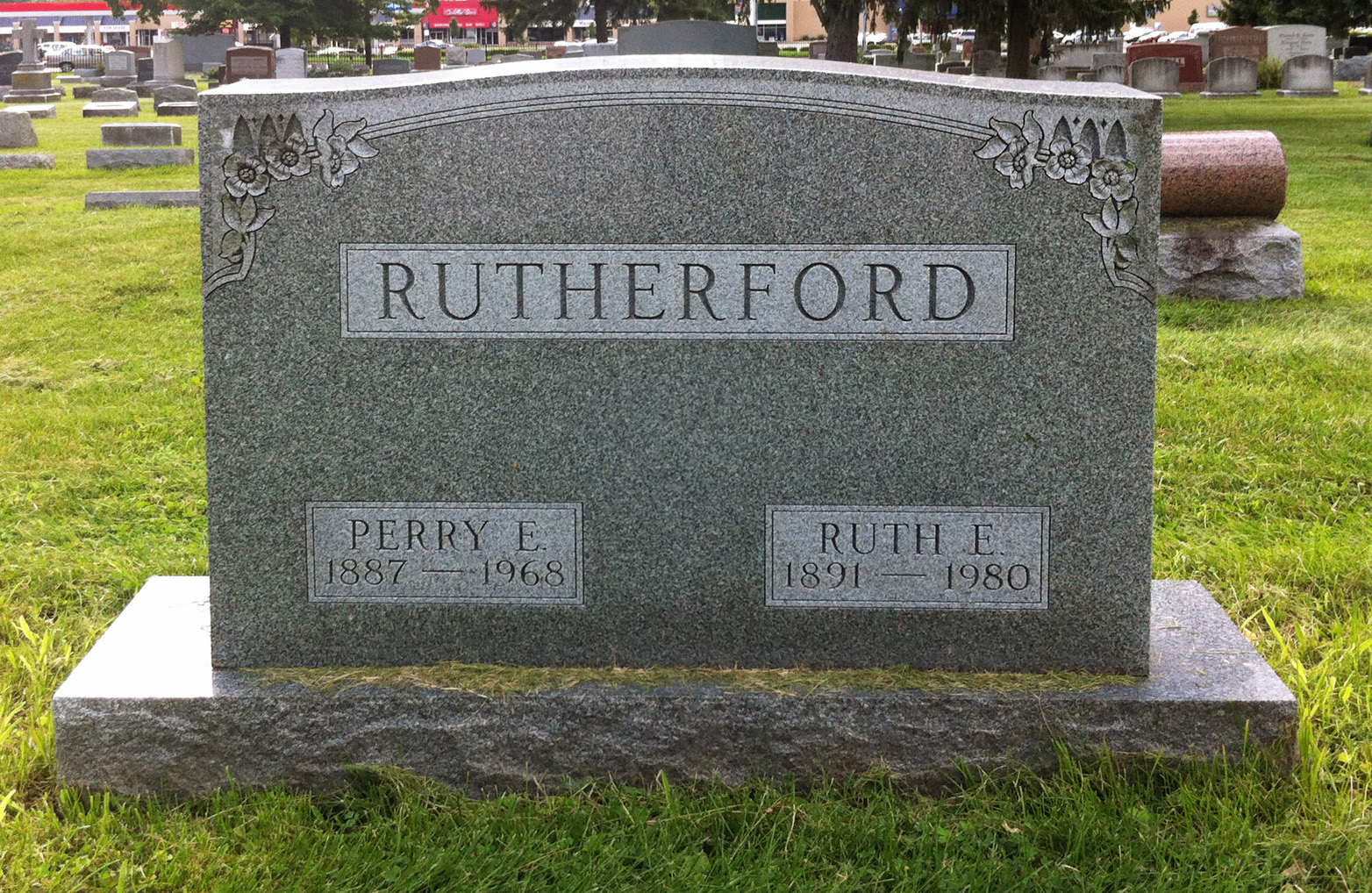
Joe Smith kindly shared this item with me, after discovering it at the Columbus Metropolitan Library. It’s A History of the North Methodist Church, Clinton Chapel, North Columbus by Ruth Ellen (Grove) Rutherford.
Ruth Ellen (Grove) Rutherford [1891-1980], a long-time area resident, wrote the history in 1970. The book includes both some history of the Clinton Chapel Cemetery, some information about the old Beers/Piatt log cabin and its move to 40 E. Norwich Ave, and info about the Underground Railroad activities of Pyrum and Polly Hunt. Joe was pleased to see mentions of his own ancestors including the Hunts–Joe’s grandfather Smith‘s maternal 2nd great-grandparents (page 16)–and his grandfather’s maternal grandparents, Horace and Sarah Theresa Young, and his mother, Minnie Belle Young, who are listed as members of North M.E. Church (page 24) in 1898. Minnie married Joe’s great-grandfather, Roy Ripley Smith, a year later, on 20 Sep 1899.
As Joe says, this is a poignant message how the Clintonville community came together and rallied around a greater cause. It’s a message of inspiration just as relevant 142 years later.
[Courtesy of Joe Smith, and the Rutherford family.]Log Home on Westwood Road
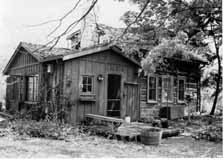 Ann Conner allowed me to see the inside of her 168 Westwood Road home when I was working on my book. You can get a glimpse of it here, in a 1988 10tv item.
Or here, as an AirBnB listing.
Maps Maps Maps
Here are some cool links for old maps:
City of Columbus Planning Maps, Historic Maps.
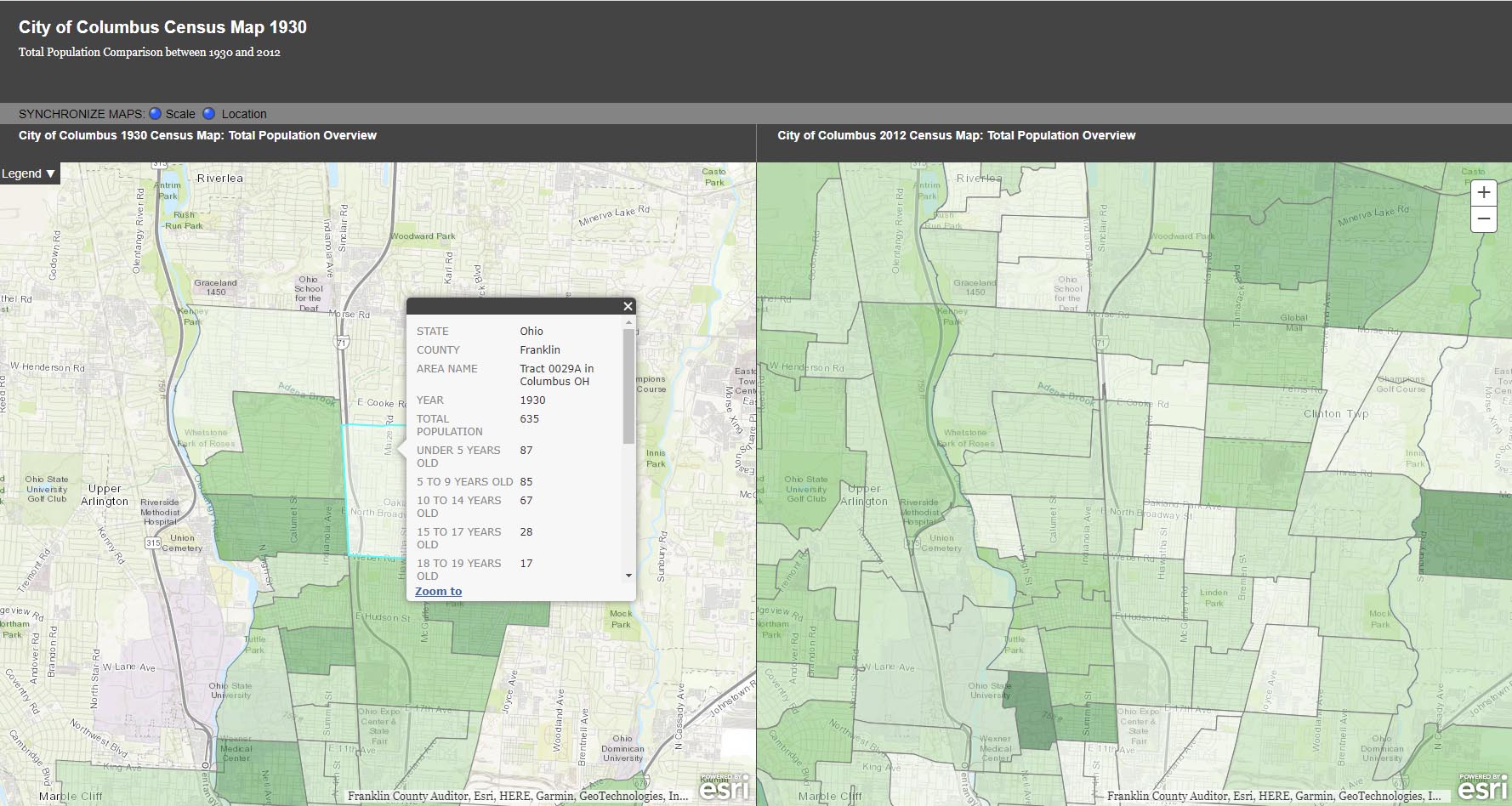
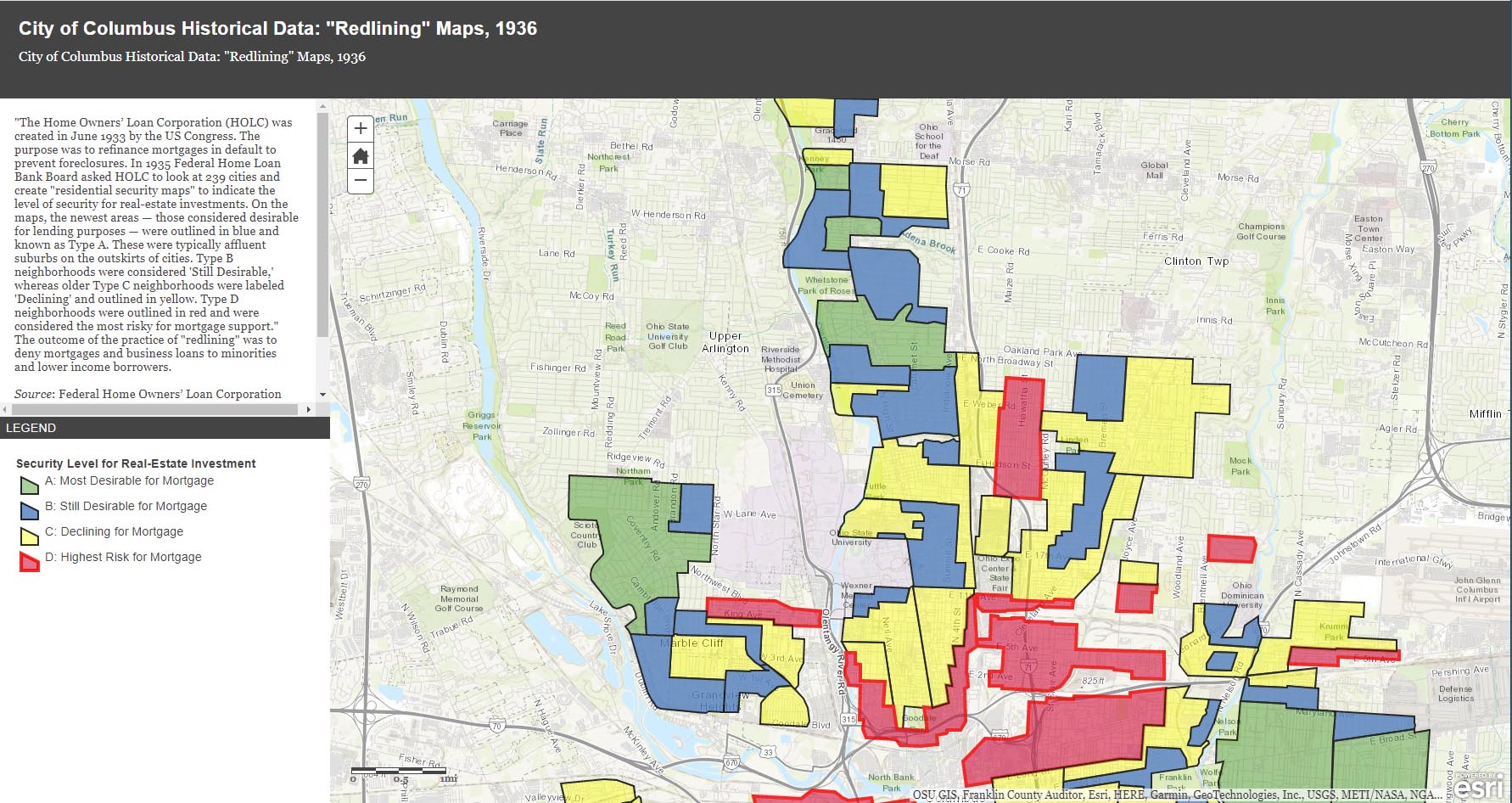
The City of Columbus’ web site gives us plenty of maps and data to play with, from Census demographic changes to despicable redlining and more. Check out especially the “City of Columbus Historic Panoramic Images, 1922,” which is based on a 1922 Ohio State University masters thesis by Forest Ira Blanchard. “Blanchard, inspired by the Chicago School of Sociology, sought to study the racial and ethnic composition of the city, with a particular focus on the role of transportation (railroads, roads) in shaping the urban landscape. Source: Forest Ira Blanchard, An Introduction to the Economic and Social Geography of Columbus, Ohio. Thesis (M.A.), Ohio State University, 1922.”
Columbus Metropolitan Library’s Columbus and Ohio Map Collection. If you haven’t donated to the library yet, now’s the time! It and and it’s staff are such great resources.
Sanborn Maps for Franklin County (scroll down to see Columbus). This is a Library of Congress site.
USGS Historical Topographic Map Explorer allows you to specify a place you want to explore, then click on a location to see its historical maps.
Prolific programmer Randy Majors has produced several products of interest, including his Historical U.S. Counties Map Tool and Auto-Checker Extension. He has also created a couple of video walkthroughs of a couple of the the software tools he has created. I recommend you view them in order, as understanding the Historical U.S. Counties map tool will help you have better success with using the Auto-Checker chrome extension.
Old Maps Online OldMapsOnline.org indexes over 400,000 maps, thanks to the archives and libraries that were open to the idea and provided their online content.
Do you know of other map resources? Let me know and I will add them to this post.
Glen Echo Beyond the Ravine

This is a nice photo from a 1922 Ohio State University masters thesis by Forest Ira Blanchard. I believe, based on the metadata, that it was taken at 2734 Indianola Ave. It is captioned, “Glen Echo section beyond the ravine.”
Blanchard, inspired by the Chicago School of Sociology, sought to study the racial and ethnic composition of the city of Columbus, with a particular focus on the role of transportation (railroads, roads) in shaping the urban landscape.
[Courtesy of Forest Ira Blanchard, An Introduction to the Economic and Social Geography of Columbus, Ohio. Thesis (M.A.), Ohio State University, 1922; digital version from City of Columbus Historic Map Collection.]