Crestview Presbyterian grows
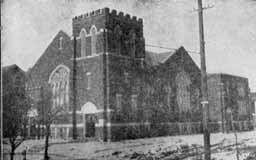 This is the newer Crestview Presbyterian Church, built in 1922 at Tulane and Esmond. (Photo courtesy of the Clintonville Historical Society)


This is the newer Crestview Presbyterian Church, built in 1922 at Tulane and Esmond. (Photo courtesy of the Clintonville Historical Society)
Around 1880, Robert Turner founded the Olentangy Villa Tavern. It was a small picnic grounds and offered boating and swimming, perhaps a couple rides. By 1895 the park came to be owned by the Columbus Railway, Power and Light Company; enabling the electric company to earn money from both its electric streetcars and from electricity at the park, and ensuring streetcar traffic (with its use of electricity) not only during weekdays when commuters traveled to their jobs in the city, but also on weekends when residents traveled by streetcar to the park. In 1899, brothers Joe and Will Dusenbury purchased about 100 acres of the park and built it up into a state-of-the-art amusement park with nationally renowned entertainment in a lovely, picturesque setting. They offered rides, a pool, bowling alley, canoeing, an amphitheatre, even a Japanese Village purchased from the St. Louis Exposition. Many long-time residents recall happy and exciting days spent at the park.
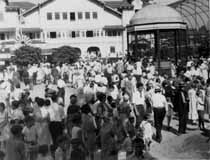
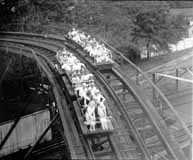
Eventually the park began to decline, and was eventually sold, and then sold a couple more times. In 1937 L.L. Leveque purchased the park and in 1939, built the Olentangy Village Apartment Community in the park’s place. (Photo courtesy of the Clintonville Historical Society)
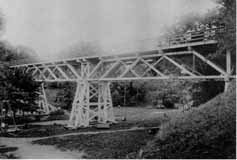 The streetcar came right to the entrance of the park, and from there attendees walked over a pedestrian bridge to get into the main park. This is a picture of the “South Glen Bridge.” (Photo courtesy of Chris Bourne)
 Loop-the-loop and Shoot-the-Chutes were among the favorite rides at the park. Loop the Loop took riders on a 360-degree vertical loop. The unruffled gentleman appears unconcerned about gravity in this well-known image of the ride. The ride was said to be accident prone and was eventually torn down. (Photo courtesy of Galen Gonser)
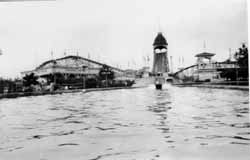 This photo shows, left to right, the Whirl Wind, Shoot-the-Chutes, and the Racer. Shoot-the-Chutes involved a long slow boat ride to the top, followed by a creaky turn, and then a steep descent, hitting water and wetting the riders to their unabashed delight. It was one of the favorite rides in the park. (Photo courtesy of Chris Bourne)
 Anyce Milam, a Columbus resident, shared these two postcards of the Olentangy Park with me for use on this web site. The first is a color picture of the ride, Loop-the-Loop, which had quite a few accidents and therefore did not last long in the park.
 The second postcard image was taken on the river near the Park’s canoe livery. The postcard was dated 1917. (Courtesy of Anyce Milam)
 was originally called the American Legion Park Playground, presumably because Post 82 owned it or gave it as a gift to the community. Today there is a conical mound at the park. The mound was “built” sometime in the 1960s (tentative date) from the dirt displaced by sewer line construction.
The house that currently stands on the north side of Orchard Lane at the river was once the Columbus Canoe Club. It has had only 4 owners in its lifetime, and the present owner had to do considerable renovation on the building. The club originally had tennis courts; the space is now a swimming pool. Sadly I know of just one photo of the club, which is located at the Ohio Historical Society. The current home owner told me that Bill Arter, an artist who drew and researched Columbus buildings in a Dispatch column called “Columbus Vignettes,” was in the process of writing a column about the club when he passed away.
 The Clinton League created a community tennis club and tennis courts on Dunedin near Calumet Street, using two vacant lots owned by J. E. Pierson.
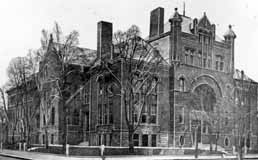 The original North High School, located at 100 West 4th Street at the corner of 4th Avenue and Dennison Avenue, had opened its doors on February 3, 1893 with eight teachers and 300 students. The student body quickly outgrew the building and an annex was constructed in 1902. That, too, became overcrowded.
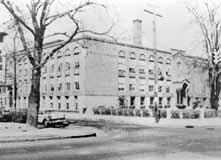 After a new high school was completed, the old building became Everett Junior High School, named after the first North High School principal C. D. Everett. This first building—designed by Frank Packard and built at a cost of $14,000—is still in use. As shown in the lower photograph, the turrets and other elaborate structures have since been removed from the school. (Photo courtesy of Columbus Metropolitan Libraries)
In 1921, the Columbus Board of Education purchased 13.15 acres for $35,000 to build a new high school. The property had been owned by the American Vitrified Products Company. The land bordered on a deep ravine; the ravine was considered to be an asset for science classes, as was the proximity of the property to the streetcar tracks. Many other sites had been considered, including somewhere on the campus of Ohio State University. Discarded bricks and baked clay shards had to be removed from the old brick yard before construction of the school could begin.
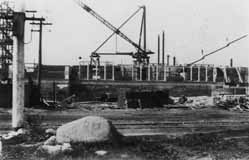
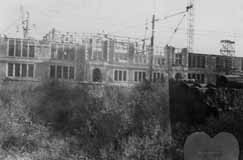
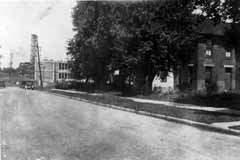
The new building was designed by architect Frank Packard and cost $1,000,000. Construction began in 1923 and the building opened on September 2, 1924. It graduated its first class in January of 1925. For a brief time, the new high school was named Edward Orton High School. It served as an anchor for the community; often three generations of Clintonville families attended the school. It was one of the city’s top college-preparation schools; between 90 and 95 percent of the students went on to higher education. North High School was closed in 1979 as part of the city’s desegregation plan and subsequently became an adult education center and has also served as temporary quarters for schools undergoing renovations. (Photos courtesy of Leeann Faust)