Home
James (Jerry) Welsh, Dairyman
Here’s a very sad story about one of our Clintonville residents from former times. James Welsh, commonly called Jerry, was a dairyman along High Street. His farm burned on January 27, 1897, and Jerry was himself badly burned in the fire. Jerry survived the fire, however, and he eventually died on Sept 5, 1905 at the age of 72 or 73 of dropsy (edema, or heart failure). He was originally from Ireland, was a Civil War veteran, and is buried in Mount Calvary Cemetery.
There’s no record of his having owned a farm on High Street or in Clinton Township, so perhaps he leased the farm land. When he died, Jerry lived at 34 Richards Road with his wife Bridget; I presume he lived close to his dairy farm. The couple also lived with a lad named Fay Osborn; Osborn is likely the 14-year old boy who was also at the scene of the 1897 fire and who was credited with saving the 20 cows.
Dairy Barn Burned
Cows Saved With Difficulty From the Flames–Loss $900.The big dairy barn of Jerry Welsh on High street above Clintonville was totally destroyed by fire Tuesday afternoon, together with a stock of fodder. In the barn at the time the blaze was discovered were about 2[0] cows and some horses. All the animals were finally removed though Welsh and his neighbors had a lively time of it taking the frantic beasts from the fiery furnace.
Luckily there was little, if any, wind and the other outbuildings and the house were saved.
There was no means of fighting the fire, and all that could be done was to run to the neighbors’ for buckets of water to pour upon the house. About [6]00 tons of millet was burned. The loss on the property will be about $900.
Was Fire at Jerry Welch’s
Dairy BarnMr. Welch Himself Badly Burned And Narrowly Escaped Death
There came near being a tragedy at the fire above Clintonville Tuesday afternoon.
It will be remembered that Jerry Welch’s big dairy barn was totally destroyed, as stated in The Dispatch at the time.
It seems that Welch, who is quite an old man, was in the barn when the fire broke out, but became so excited that had it not been for the efforts of a 14-year-old boy who was in an adjoining field gathering fodder, over 20 cows would have been burned. The lad released the maddened animals just as the roof of the structure fell in.
All this time Welch was working heroically at the other end of the barn endeavoring to save the horses. In some way he slipped and fell right into the awful furnace. He was dragged therefrom by a neighbor who had hastened to the scene. Welch’s hair was singed, his hand and face badly scorched, and he would have burned to death had not the neighbor pulled him out and extinguished the fire by rolling the victim in the snow.
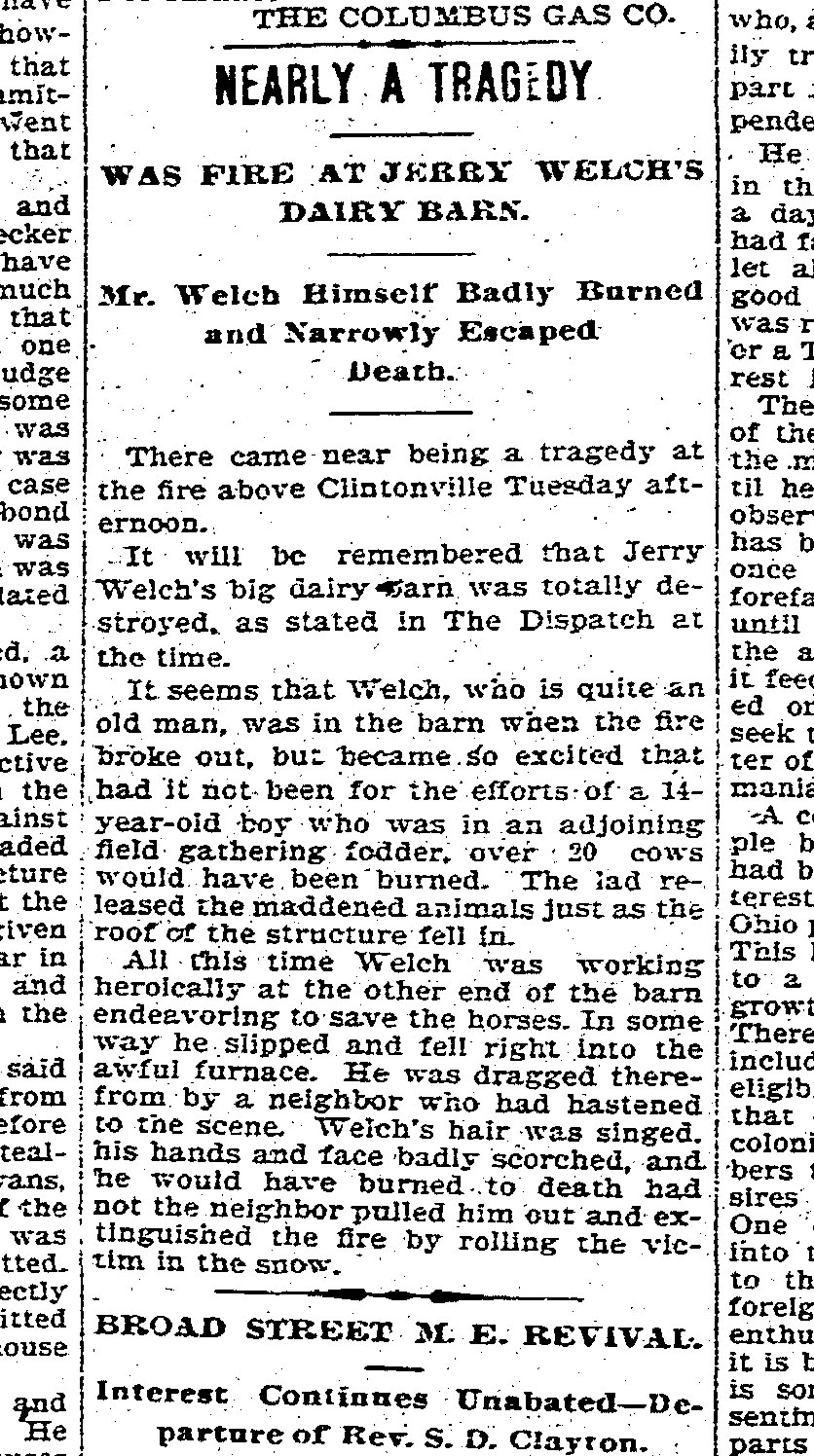
Cindy at the Columbus Metropolitan Library shared most of the above details about Mr. Welsh with us. She writes: “I was able to find a little more information about Jerry Welsh. First, I believe the name was actually Welsh, not Welch [as in the 2nd article above]…I am attaching Mr. Welsh’s obituary. I was able to find him on the 1900 census with his wife, and it looks like he was a veteran of the Civil War because I found a grave registration card that matches up with his grave information in Mount Calvary Cemetery. Unfortunately, I was not able to find that he owned any property in Clinton Township. I checked maps, including a 1895 plat map that has landowners names on it. I also checked deed indexes on the recorder’s site for that time frame for both grantors and grantees and still did not find anything. It is possible he was renting the land that the barn was on.”
I do love our Columbus Metropolitan Library System and especially appreciate the Local History and Genealogy staff. THANK YOU CINDY!
318 Orchard Lane (Columbus Canoe Club)
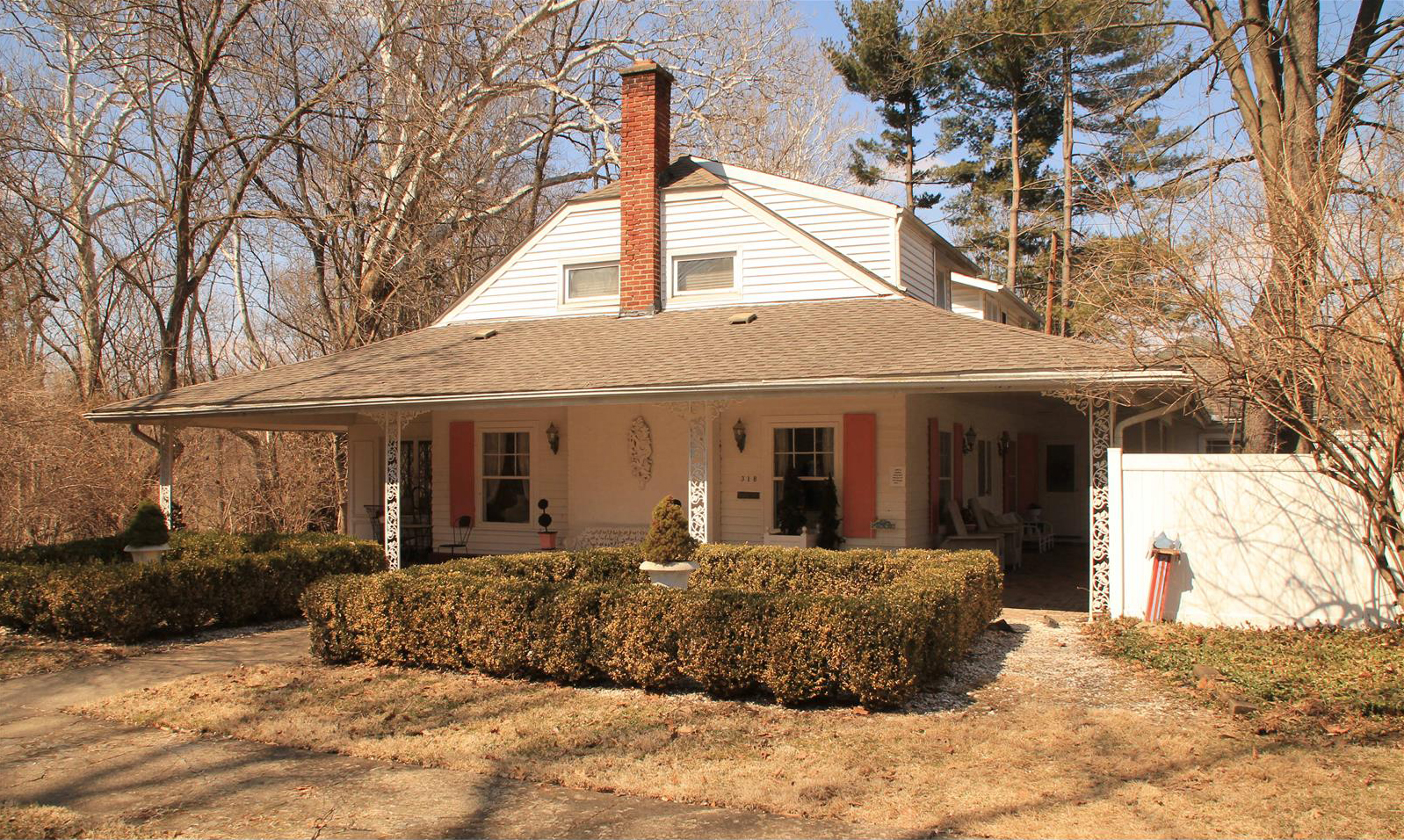 The Columbus Canoe Club–which had been turned into a residence back in 1959–was currently on the market, and you can see the inside of this residence here. It has only had 4 owners since it was built, and long-time owner Donna Hickey had given me a tour of the house back in 2009. So sorry to learn that Donna passed away in 2021.
A bit more info here
(I doubt this link to the realtor post will be up long.)
In Honor of Armistice Day
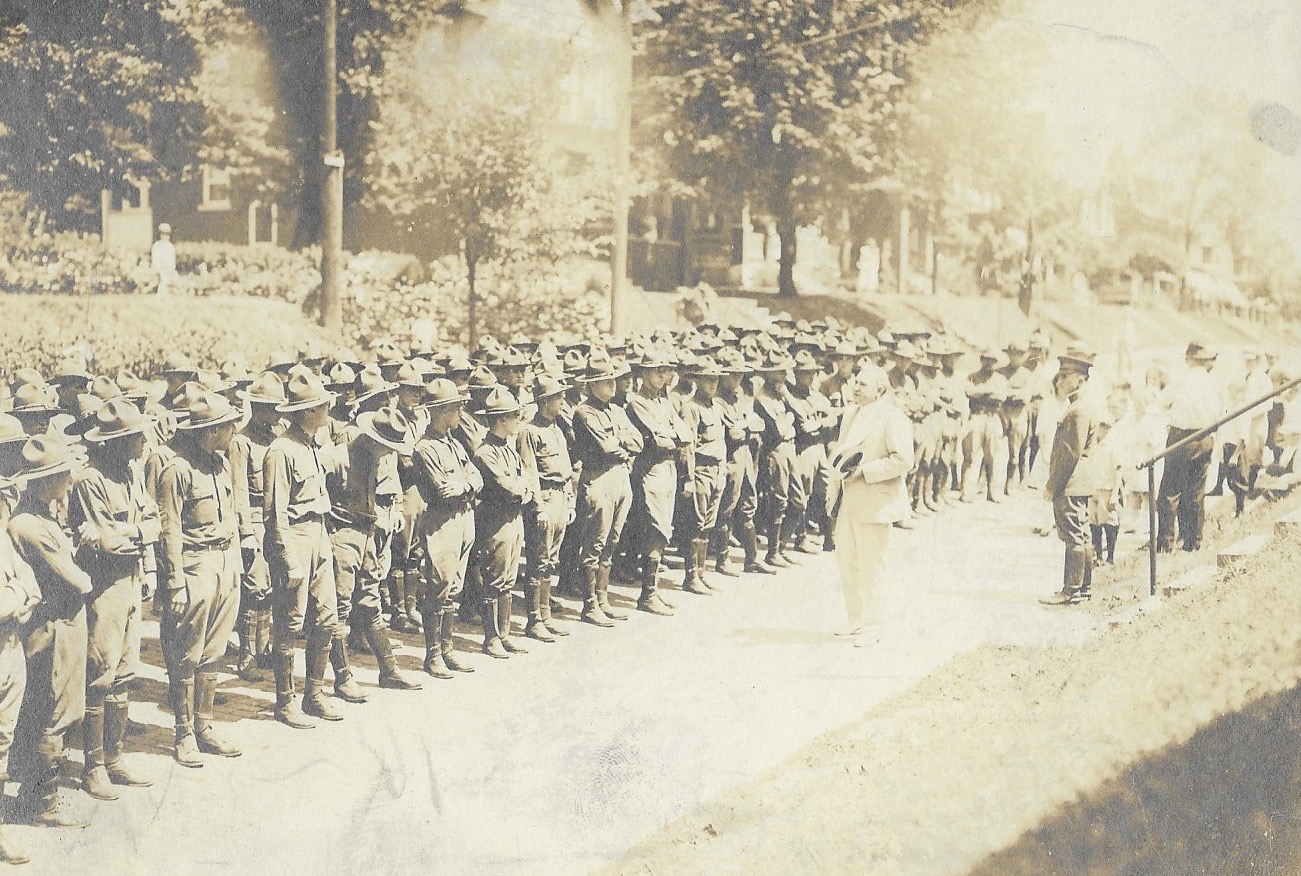 I have no World War I photos of soldiers in Clintonville. But in honor of Armistice Day aka Veterans Day, I am posting this photo of WW I soldiers, being addressed by Norman Barnes Thorp. This might be in front of 180 East Northwood, though I have been unable to confirm that location.
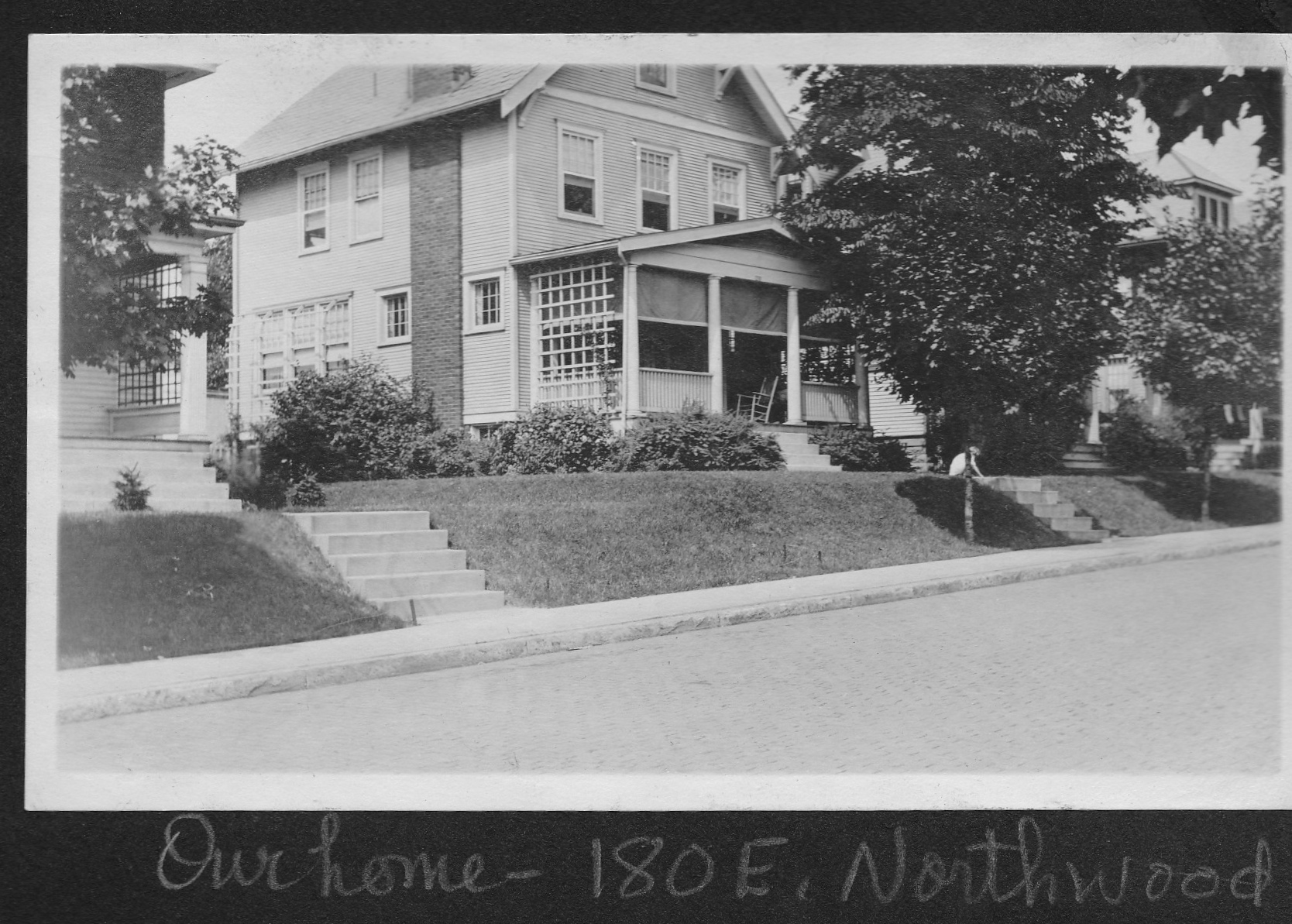 Margaret Nelson, a long time Clintonville resident who has shared many other family pix with us, shared the World War I photo with us. 180 East Northwood was built by Margaret’s grandparents, Johanna Gertrude (Edmondson) (1880-1967) and Norman Barnes Thorp (1867-1934) around 1909, and the house was subsequently owned by the Thorp’s daughter, Norma Thorp Van Ness.
Norman B. Thorp was active in the Northwood Flower and Garden Club, which in turn was active in various ways in the war effort. Of its 60 members, 9 men were in military service and 1 woman was an active nurse.
[Photos courtesy of Margaret Nelson.]School Mate? Or Soul Mate?
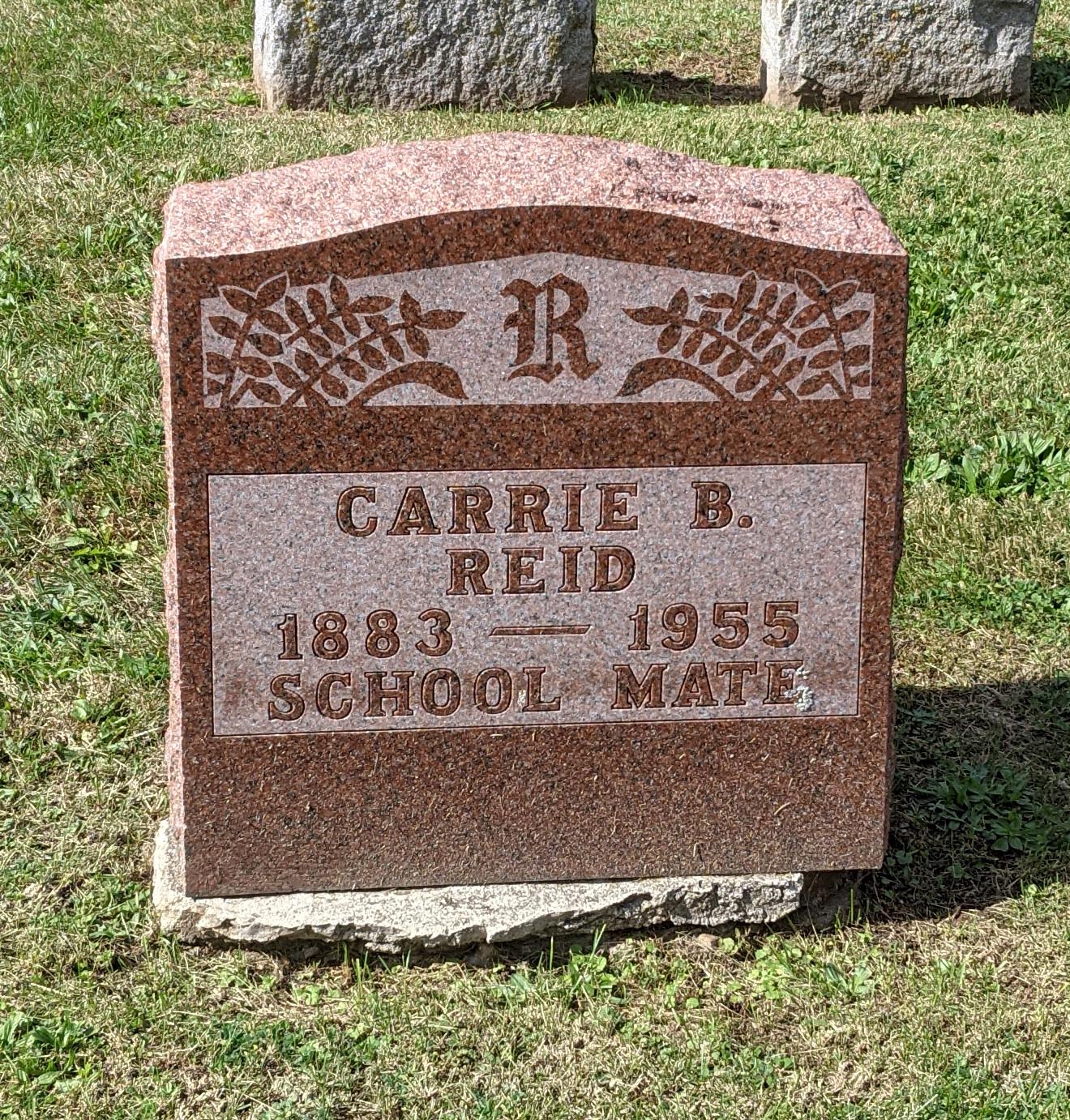
On one of my daily walks, I noticed this grave in Union Cemetery, which set me a wonderin’. “School Mate” is such a peculiar thing to put on a grave marker! I did a bit of research, and Wendy Ritter Bayer joined me in the effort.
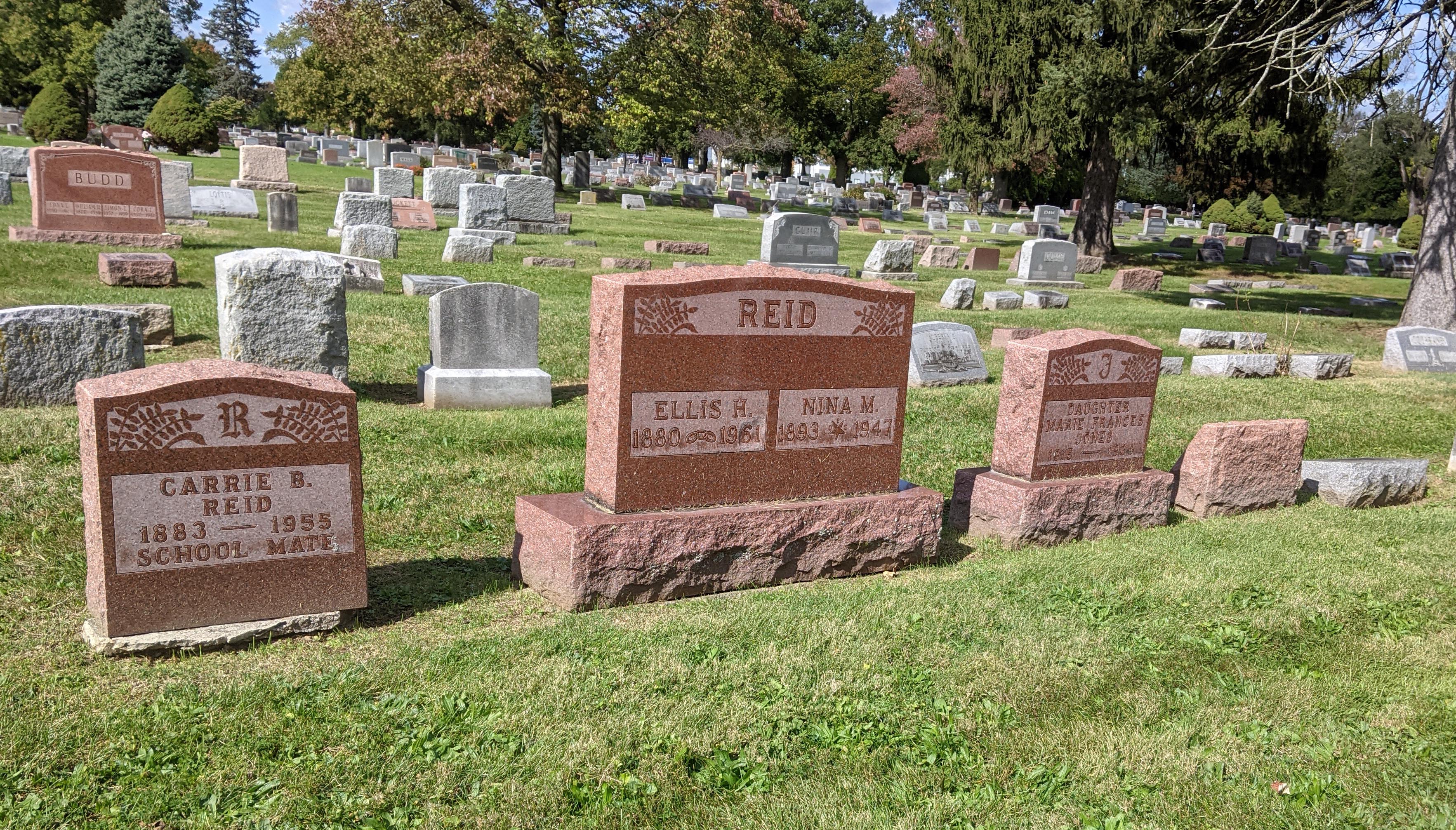 Here is the cluster of gravestones I was so curious about: Carrie Reid, Ellis & Nina Reid, Mary Frances Jones. Carrie Reid’s epitaph says “School Mate” but she shares a last name with Ellis and Nina Reid, and is their general age. Also, she died in her 70s, so it seemed unusual to hark back to her school friends.
Gravestones left to right are: Carrie Reid, Ellis & Nina Reid, Mary Frances Jones. Carrie Reid was Ellis’ 3rd and final wife. Nina married then was divorced from Ellis yet was buried alongside Ellis. Mary Frances is Nina’s child by a previous marriage.
(1) Ellis Harlen Reid was married 3 times:
–Flora Ellen Rice m. 1902. In 1903 he and Flora had 1 son, Russ, who died in 1991. Ellis and Flora presumably divorced.
–Nina Jones m. 1927. For some reason Ellis’ second wife Nina owed his first wife Flora $500 for a real estate matter which was paid in full by May 1937. Ellis Reid filed for divorce from Nina in May 1947, the same year Nina died–in September 1947–after a couple month’s illness “survived by her husband Ellis.”
–Carrie B Quinn m. 1950. Three years after divorcing Nina, Ellis married Carrie B. Quinn, who predeceased him.
(2) Nina was married 2 times:
–Thomas W Jones in West Virginia; he died in 1965 so presumably they divorced. They had a daughter, Marie Frances Jones; Marie died in 1934 and her stone is next to her mother’s.
–In 1927 she married Ellis Reid, divorced him in 1947, and died later that year. Her house at 524 Lincoln Ave was to be sold and proceeds paid “to my niece, Sylvia Cole, and my sister Ivy Robinson, share and share alike, or to the survivor of them.”
(3) Carrie was married 4 times:
–Oscar Bowman m. 1901; he died in 1954 so she must have divorced him. Carrie and Oscar had 2 living daughters: Bertha Leola, born 1903, and Helen E., b. 1906. Their address was 1268 1/2 N. High St. (Bertha married James Dolan in 1921 and Helen married Charles A. Taylor on 16 Aug 1927). Carrie and Oscar also had an infant daughter who died of “pre-mature birth” in 1909. Their address was 1181 Say Ave.
–Elmer Preston Buchanan m. 1918; he died in 1956 so presumably they divorced.
–Loren George Webster m. 1939; he died in 1940 from “barbital poisoning (addict).”
–Ellis Reid, m. 1950. He was 70, she was 67 when they married; she died 5 years after marrying him. He died in 1961.
I’m surprised at the sheer number of divorces–at least 4 between them. Ellis is buried alongside his second wife, rather than his 3rd and final wife, though that’s not all that uncommon; cemeteries and monument sellers often offer a “2 for one” price, so widowers ended up with a plot they might otherwise be unable to use. Also it wouldn’t surprise me if somehow Nina was instrumental in the choice, since her daughter by previous marriage is in the same plot and style stone.
Now, back to my original inquiry. Carrie was born and raised in Ohio, as was Ellis. Nina was born and raised in WV. So if Carrie was a “school mate,” it was with Ellis. I am unable to research whether that happened. But what kind of husband puts “school mate” on his newly deceased, current, wife’s stone? I’m wondering whether she was a SOUL Mate and the carvers got it wrong. If so, what a hoot.
Indian Springs 1922
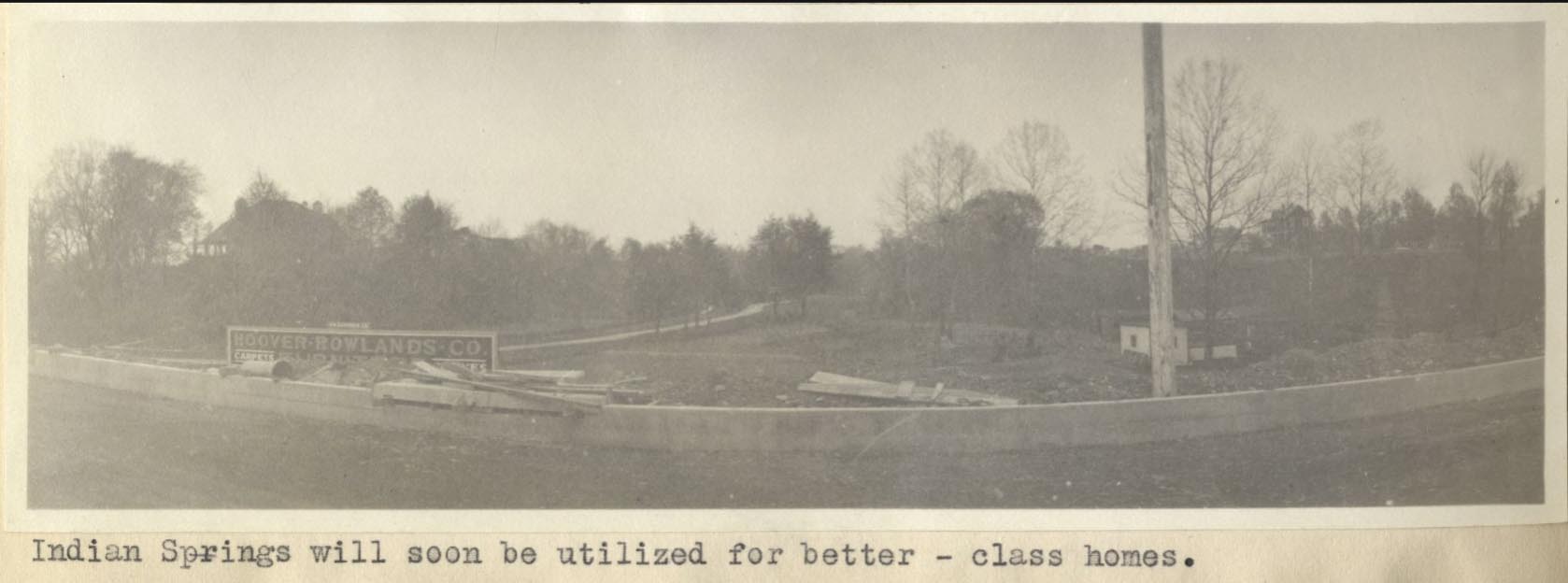
This is a nice photo from a 1922 Ohio State University masters thesis by Forest Ira Blanchard. I believe, based on the metadata, that it was taken at 70 E Henderson Rd. It is captioned, “Indian Springs will soon be utilized for better-class homes.”
It makes me curious about the “class of homes” about to be torn down.
Blanchard, inspired by the Chicago School of Sociology, sought to study the racial and ethnic composition of the city of Columbus, with a particular focus on the role of transportation (railroads, roads) in shaping the urban landscape.
[Courtesy of Forest Ira Blanchard, An Introduction to the Economic and Social Geography of Columbus, Ohio. Thesis (M.A.), Ohio State University, 1922; digital version from City of Columbus Historic Map Collection.]Rosemary & Rosemary South Plat Map 1923
 Here’s a nice plat map from 1923 of the Rosemary housing development.