Home
A Lot of Bull
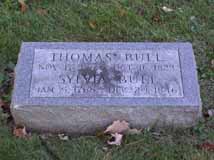 People like to say that the story of Clintonville starts with the story of Thomas Bull Jr., who came to this area in 1812 with his family from Vermont, by way of Worthington. Bull purchased about 680 acres in Clinton Township, and bequeathed land to his children when he died in 1823. Bull and his family were Methodists and abolitionists. The family graves were moved in March 1910 to Union Cemetery, section “new”, lot 176, across from the flagpole. (Despite the section name, this is in the old area of Union Cemetery on the east side of Olentangy River Road.)
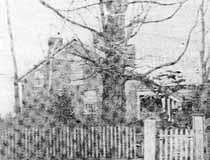 This is the Thomas Bull residence which stood on the east side of High Street between Dunedin and Piedmont. Some of the information about the house is conflicting, but Nancy Pendleton states that Alonson Bull helped to build the house around 1821 and lived there until the mid-1860s. The local Methodist congregation held services in this house until Thomas Bull’s death in 1823. Elias Pegg purchased it, along with its farm, in 1862 and raised his children there. The house was torn down in August 1931. This photo is from the Sunday edition of Cols Dispatch March 5, 1950.
Brevoort & Bull Graves
Thomas Bull’s daughter Chloe came to the area with her husband Isaac Brevoort and son Henry around 1812. Isaac Brevoort was helping build a barn across the Olentangy River and was crossing the flood-swollen river in February 1814 when his boat was swamped and he drowned. He was 23 years old, and was buried just 100 yards from the river. That grave is now someone’s back yard. Some say the grave is behind 247 Kenworth; some sources say it’s behind 253 Kenworth; some sources say that Isaac Brevoort is buried behind 253, and Thomas Bull Senior (father of Thomas Bull Junior) is behind either 247, or 253, or 257.
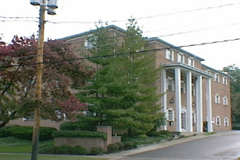 Henry Brevoort’s house was built at 3620 North High Street, behind the original Brevoort cabin. The house continued to exist until around the 1970s, when it was torn down. The Brevoorts had an 80 acre farm; Developer Charles Johnson purchased the farm in 1909, and planned the Northmoor neighborhood carefully. He had the idea that vacant space induced people to build a nice house. Accordingly, he platted Northmoor Park and gave it to the city. He also did this with the bird sanctuary that today is known as “the Delta,” at the west end of Webster Park.
An early 1970s article stated that “stones still mark the [Brevoort] cabin” and that “once past the field stone gateposts [which were just wide enough for a carriage], the ancient barn where Frank Brevoort once operated a dairy still stands.” Does any of this still exist?
Post Office
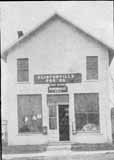 Clintonville was never platted as a formal village. Alanson Bull, the son of Thomas Bull, sold several small lots to tradesmen for their shops. Located at the northwest corner of High Street and Orchard Lane, a post office opened in 1847, in a two-story frame building on the northwest corner of High Street and Orchard Lane, and was given the name Clintonville because it was located at the center of Clinton Township. (This building has since been torn down.) The postmaster conducted a rag rug business upstairs. High Street at that time was a dirt and plank turnpike connecting Columbus with Worthington and Sandusky. In 1913 a new two-story brick building was erected on Dunedin at High. Mr. Legg operated a grocery store; Mrs. Legg sold notions. The post office moved there and remained until 1917—when, according to one source, RFD was offered, and according to another source, because the area was annexed by the city of Columbus. (I believe this second post office was a small building behind the corner building.) (Photo courtesy of the Clintonville Historical Society)
Underground Railroad
Alonson Bull and his brother Jason were abolitionists, Jason serving as a “conductor” on the Underground Railroad from Clinton Chapel at 3100 North High Street. Jason’s photograph is in the Wilbur H. Siebert Collection at the Ohio Historical Society.
Edward L. Sebring (1839?-1905) worked with Jason Bull to aid fugitive slaves escaping to freedom in Canada from Columbus, Franklin County, Ohio, to the next safe station. His photograph is in the Wilbur H. Siebert Collection of the Ohio Historical Society.
James G. Bull
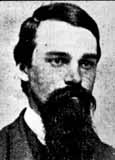 James G. Bull (1838-1927) was a grandson of Thomas Bull. James served as Columbus Mayor from 1865 to 1868 and from 1871 to 1875. His grandfather, Thomas Bull, was the first white settler of the area and James’ father, Alonson Bull, founded Clintonville in 1846. (Photo courtesy of Columbus Metropolitan Libraries)
Other early settlers…
include the Smiths, Websters, Coes, Whipps, Hunts, Wilsons, Bucks, and the Cookes. John Buck acquired land around Henderson and High early on, and then sold some of the land to Chauncey Cooke. Cooke in turn donated the land to the Clinton Township in 1842 to be used as a school.