Home
Cooke Cemetery
The Cooke family cemetery was located near the southeast corner of Cooke Road and High Street. According to genealogy records, the earliest headstone dated to 1817. Most of the graves were moved to Greenlawn or Union Cemeteries when Bishop Watterson High School was built in 1958. A few headstones were later discovered on a lot on Lenappe Drive. I would love to have some pictures of this cemetery.
There was also a John Rathbone Cemetery at the intersection of Morse and High.
George P. Whipp (b. 1817)
George Whipp came to the area with his wife and two sons from Maryland in 1833. His son George P. was 16 years at the time, and initially worked as a carpenter. Son George married Lucinda Smiley, and they had 10 children one of whom was also named George. The family farmed and had two truck stands along North High Street. (Note: Sometimes the family spells its name with one “p”.) A bit more biographical information can be found in A Centennial Biographical History of the City of Columbus and Franklin County Ohio (Chicago: The Lewis Publishing Company, 1901) p. 770 excerpted here.
Whip family
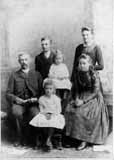 One of the oldest families in Clintonville is the Whipp Family (sometimes spelled Whip). They owned a farm, and a couple of stands along High Street that had big large orange signs advertising a refreshing drink consisting of freshly squeezed orange juice. The Whipps may have been the first owners of the mill located just north of Henderson Road and the Olentangy River. Here is a picture of the Whipp family circa 1889: George, Oscar, Everett, Laura, Cora, and Mabel. (Photo courtesy of Sue Gallogly)
The Whips lived at 73 East Weisheimer.
Schreyer house
How I would love to acquire a picture of the old Schreyer House. This was described as being one of the first high-class homes in its neighborhood. The property was 50 acres, from High Street to the Olentangy River, bounded by Henderson to the south and the “Stewart and Weisheimer farms to the north.” The grand house was built by Barney Phinney (one of the owners of the Worthington Pike) about 1893, and was subsequently sold to G. Schreyer, a Columbus stove and furnace manufacturer.
Two excellent orchards grew on the place. A windbrake of splendid walnut trees protected one orchard and a row of fine maples formed the windbrake for the other. There was also a very good spring just west of what is now Rosemary Parkway. Surrounded by rose gardens and shrubbery, the house was an imposing structure with pointed gables and the interior finished throughout with solid walnut.
Mr. Schreyer died in 1901, and his wife (Ernestine Zeller, after whom Zeller Road was named) moved elsewhere. The old Schreyer house was eventually subdivided into apartments. The house burned down in 1913; the Columbus Fire Department had been called but could not respond, because there were no water lines in that vicinity at the time. The land was purchased by Charles Johnson in 1923 and subdivided into the Rosemary Development.
And as a side note: “Rosemary” was the name of Charles Johnson’s mother.
Train Wreck
 This is a train wreck that occurred in 1880 north of Hudson, at the Big Four Railroad tracks. (Photo courtesy of Judy Cohen)
Dodridge Bridge
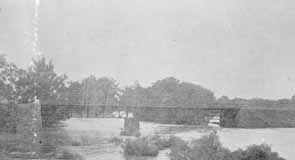 As my book shows, there was once a covered bridge over the Olentangy River at Dodridge Road. The Dodridge covered bridge was replaced by a truss bridge built by the Columbus Bridge Company. This picture shows the replacement bridge in 1890. Fishing from the bridge was a favorite activity for many 20th century Clintonville residents. It was a lovely river, and crappy and small mouth bass abounded. (Photo courtesy of Columbus Metropolitan Libraries)