

Beginnings
 Balser Hess, a cordwainer, tanner and Revolutionary War veteran, was one of the first pioneers to arrive in Clinton Township. Hess came to Ohio with his family and bought 320 acres of land along the west bank of the Olentangy River. His first house, a log structure, was a common stopping place with travelers. Balser died in 1806 and was the first to be buried on the grounds that became Union Cemetery. (Photo courtesy of Terry Miller.)
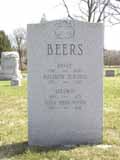 David Beers was another early pioneer with an exciting life story of having been captured and released by the Native Americans. Beers came to Ohio in 1802. Descendents of David Beers still live in the area to the present day. (Photo courtesy of Terry Miller)
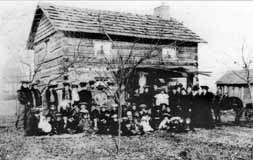 Beers had a log house near the intersection of Dodridge and North High Street. The cabin still exists but has been moved to Norwich Avenue. This photo appeared in the December 29, 1904 Dispatch, on the house’s centennial. The people included friends, relatives, and associates of the cabin’s next owner, Conn Baker, and they were reminiscing with him about early Columbus and marking the 100th anniversary of the cabin after the its move and reassembly to E. Norwich.
 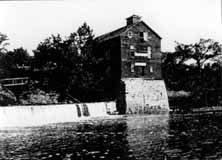 The Beers family operated a mill which existed until the early twentieth century. For many years the father of the well-known poet John James Piatt operated it. The future poet spent his boyhood days playing about the mill, and some say that the impressions made by its surroundings found expression in his work. The mill was considered to be one of the most picturesque spots in Ohio. Built around 1810, the mill burned in 1902.
 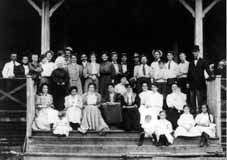 The reason for this gathering is unknown, but it includes several Beers descendants (and likely many who are not related) and was taken about 1905, probably at Olentangy Park. (Photos courtesy of Marty Cottrill)
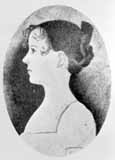 Eliza Rathbone Wetmore’s father, John Rathbone, acquired 4000 military land grant acres including all of Beechwold and much of Clintonville. John Rathbone gave Ohio a loan to build the Ohio canal and bequeathed 262 acres of land to his daughter Eliza. Eliza married Charles H. Wetmore, a physician, and the young couple settled in Clinton Township in 1819. Her land would eventually be purchased by the Columbus Zoological Company and would eventually become Old Beechwold. Some say that the stone pillars are the remains of the Wetmore driveway. (Courtesy of Columbus Metropolitan Libraries.)
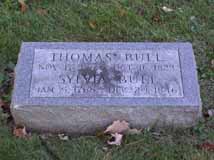 People like to say that the story of Clintonville starts with the story of Thomas Bull Jr., who came to this area in 1812 with his family from Vermont, by way of Worthington. Bull purchased about 680 acres in Clinton Township, and bequeathed land to his children when he died in 1823. Bull and his family were Methodists and abolitionists. The family graves were moved in March 1910 to Union Cemetery, section “new”, lot 176, across from the flagpole. (Despite the section name, this is in the old area of Union Cemetery on the east side of Olentangy River Road.)
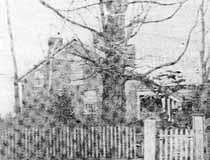 This is the Thomas Bull residence which stood on the east side of High Street between Dunedin and Piedmont. Some of the information about the house is conflicting, but Nancy Pendleton states that Alonson Bull helped to build the house around 1821 and lived there until the mid-1860s. The local Methodist congregation held services in this house until Thomas Bull’s death in 1823. Elias Pegg purchased it, along with its farm, in 1862 and raised his children there. The house was torn down in August 1931. This photo is from the Sunday edition of Cols Dispatch March 5, 1950.
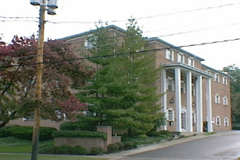 Henry Brevoort’s house was built at
 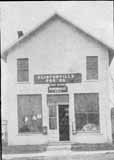 Clintonville was never platted as a formal village. Alanson Bull, the son of Thomas Bull, sold several small lots to tradesmen for their shops. Located at the northwest corner of High Street and Orchard Lane, a post office opened in 1847, in a two-story frame building on the northwest corner of High Street and Orchard Lane, and was given the name Clintonville because it was located at the center of Clinton Township. (This building has since been torn down.) The postmaster conducted a rag rug business upstairs. High Street at that time was a dirt and plank turnpike connecting Columbus with Worthington and Sandusky. In 1913 a new two-story brick building was erected on Dunedin at High. Mr. Legg operated a grocery store; Mrs. Legg sold notions. The post office moved there and remained until 1917—when, according to one source, RFD was offered, and according to another source, because the area was annexed by the city of Columbus. (I believe this second post office was a small building behind the corner building.) (Photo courtesy of the Clintonville Historical Society)
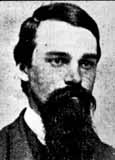 James G. Bull (1838-1927) was a grandson of Thomas Bull. James served as Columbus Mayor from 1865 to 1868 and from 1871 to 1875. His grandfather, Thomas Bull, was the first white settler of the area and James’ father, Alonson Bull, founded Clintonville in 1846. (Photo courtesy of Columbus Metropolitan Libraries)
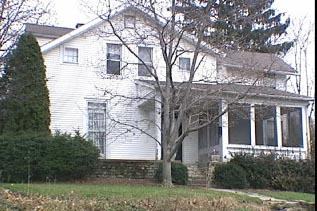 … is credited with starting Kenyon College somewhere near North High Street and Selby Roads, in a house that has since been razed. An earlier home of