


Bank
The Citizen’s Trust & Savings Bank, Clintonville Branch, was located in 1926 at 3296 North High Street. Left to right are Fred Horch, manager; Earl Buchler, manager, Steelton Office; Karl Kegelmeyer, manager produce exchange office; and Hershel Hill, assistant. It later became the Ohio National Bank, then Banc Ohio National Bank.





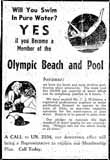 I love this ad for Olympic Beach in 1939. “Of interest to the ‘bathers’ of Northern Columbus is the care and precaution the management of the Olympic Pool is taking so that our families may swim in perfectly safe water, free from impurities and its dangers…“ Shortly after the pool was built, the Olympic Amusement Corporation, headed by Orr Zimmerman, assumed ownership of the pool. For many years the O.S.U. swimming and diving teams practiced there and many contestants for the summer Olympics came from all over the United States to train at the pool. Several national championships have been held there. Early on, only male lifeguards worked at the pool.
 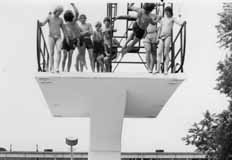 Here, someone does a kamikaze dive off the tallest tower. (Photos courtesy of the Zimmerman family)
 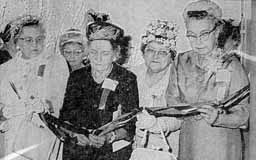 The women were Mrs. Walter H. Ives, Mrs. Herman O. Williams, Mrs. Frank Hiatt, Mrs. Russell Kennett, Mrs. Harry Mesloh, and Mrs. Rand P. Hollenback. Each woman made a list of representatives of all the local organizations and churches, and recruited them. The result was a list of 40 charter members. Their objective was “to encourage wholesome community life, to promote acquaintance among women of varied interests; and to secure cooperation in social, educational, civic, and welfare work in Clintonville.” They met in small groups, rotating the meetings between member’s houses. They also had 18 special interest groups. The annual dues were $3, $1 of which was set aside to build a club house. They achieved that goal through the generosity of the Kiwanis Club, which in 1951 gave the women’s club land on which to build at