Clintonville History header
Clintonville History photos
Clintonville History header
Clintonville History photos

About Clintonville Book

This author has not yet filled in any details.
So far Clintonville Book has created 431 blog entries.

Creative Reuse of a Garden House

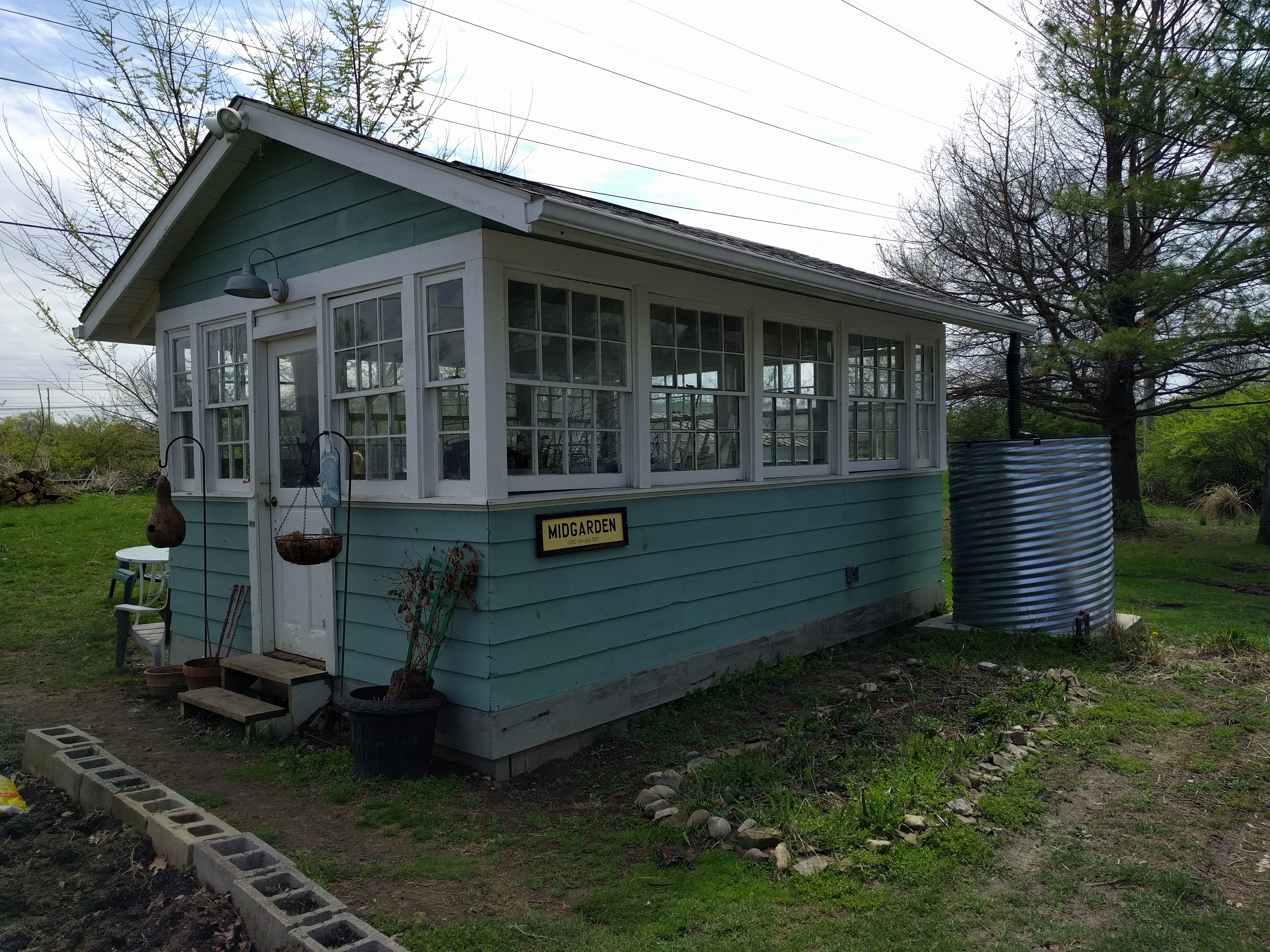
This little gem was once the garden house at Edgewater, summer home of Harvey and Emma Legg Zinn. (Harvey was founder of the Zinn Lumber Company.) It dates to the 1920s. Zinn’s property at the west end of Kenworth was eventually subdivided and several years ago an additional new house was built on the property.

During construction of the new house, the builder, Kevin Clausen, used the garden house as an office for the building project (shown here in 2014).

Upon the house’s completion, the new homeowners, Gary and Kathy Flynn, donated this lovely shed to Clintonville Resource Center (CRC) instead of demolishing it. Thanks to the Clintonville Historical Society, the American Public Gardens Association, builder Kevin Clausen and some hearty volunteers, it was moved to its new home at the CRC Midgard Community Garden (aka Midgarden). The foundation work was completed in 2017 with the help of Tim Beachy and Anderson Concrete.

This building enables CRC staff and volunteers to collect rainwater for irrigation, start new plant seedlings on site, retrieve seeds for new plantings and provide a space for educational and informational gatherings. And of course, it adds a shedful of pretty to the landscape.

2020-06-15T20:51:46+00:00June 15, 2020|Categories: 1900-1940, 1940-present, Houses, Organizations|0 Comments

Calling Doctor Amy!

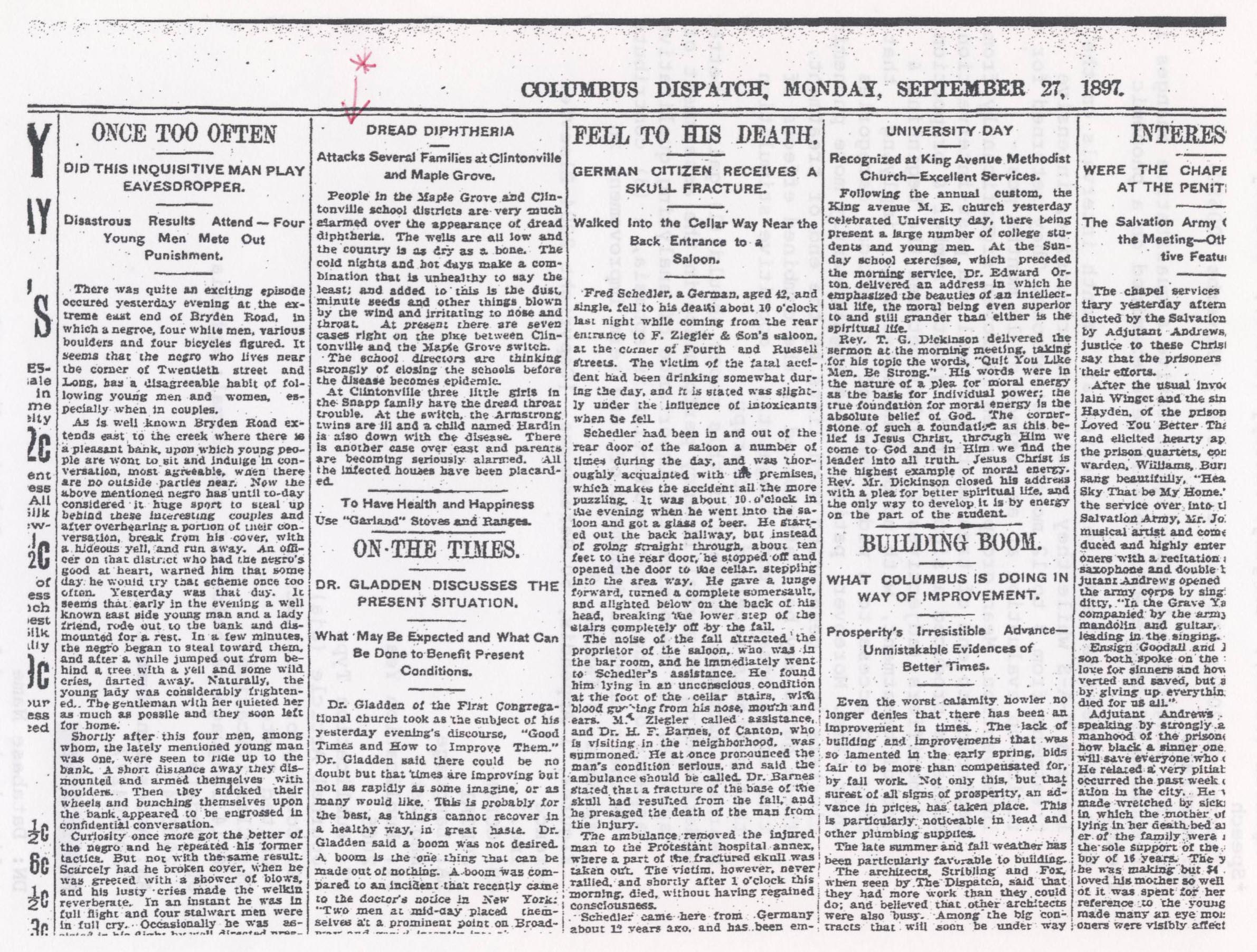
This is a Columbus Dispatch article, dated September 27, 1897, about an almost-epidemic of diphtheria. Though you can zoom in, the print is tiny, so I’m providing the text here:

Dread Diphtheria Attacks Several Families in Clintonville.

“People in the Maple Grove and Clintonville school districts are very much alarmed over the appearance of dread diphtheria. The wells are all low and the country is as dry as a bone. The cold nights and hot days make a combination that is unhealthy to say the least; and added to this is the dust, minute seeds and other things blown by the wind and irritating to nose and throat. At present there are seven cases right on the pike between Clintonville and the Maple Grove switch.

“The school directors are thinking strongly of closing the schools before the disease becomes an epidemic.

“At Clintonville three little girls in the Snapp family have the dread throat trouble. At the switch, the Armstrong twins are ill and a child named Hardin is also down with the disease. There is another case over east and parents are becoming seriously alarmed. All the infected houses have been placarded.”

According to Wikipedia and the CDC, diphtheria is an infection caused by the bacterium Corynebacterium diphtheriae. Signs and symptoms vary from mild to severe. They usually start two to five days after exposure. Symptoms often come on fairly gradually, beginning with a sore throat and fever. In severe cases, a grey or white patch develops in the throat; this can block the airway and create a barking cough as in croup. The neck may swell in part due to enlarged lymph nodes. Complications may include myocarditis, inflammation of nerves, kidney problems, and bleeding problems due to low levels of platelets. Nowadays, children are vaccinated against diphtheria in combination with tetanus and pertussis.

2020-05-18T15:25:27+00:00May 18, 2020|Categories: 1800s, People, Schools|Tags: , |1 Comment

The Perennial Parking Problem

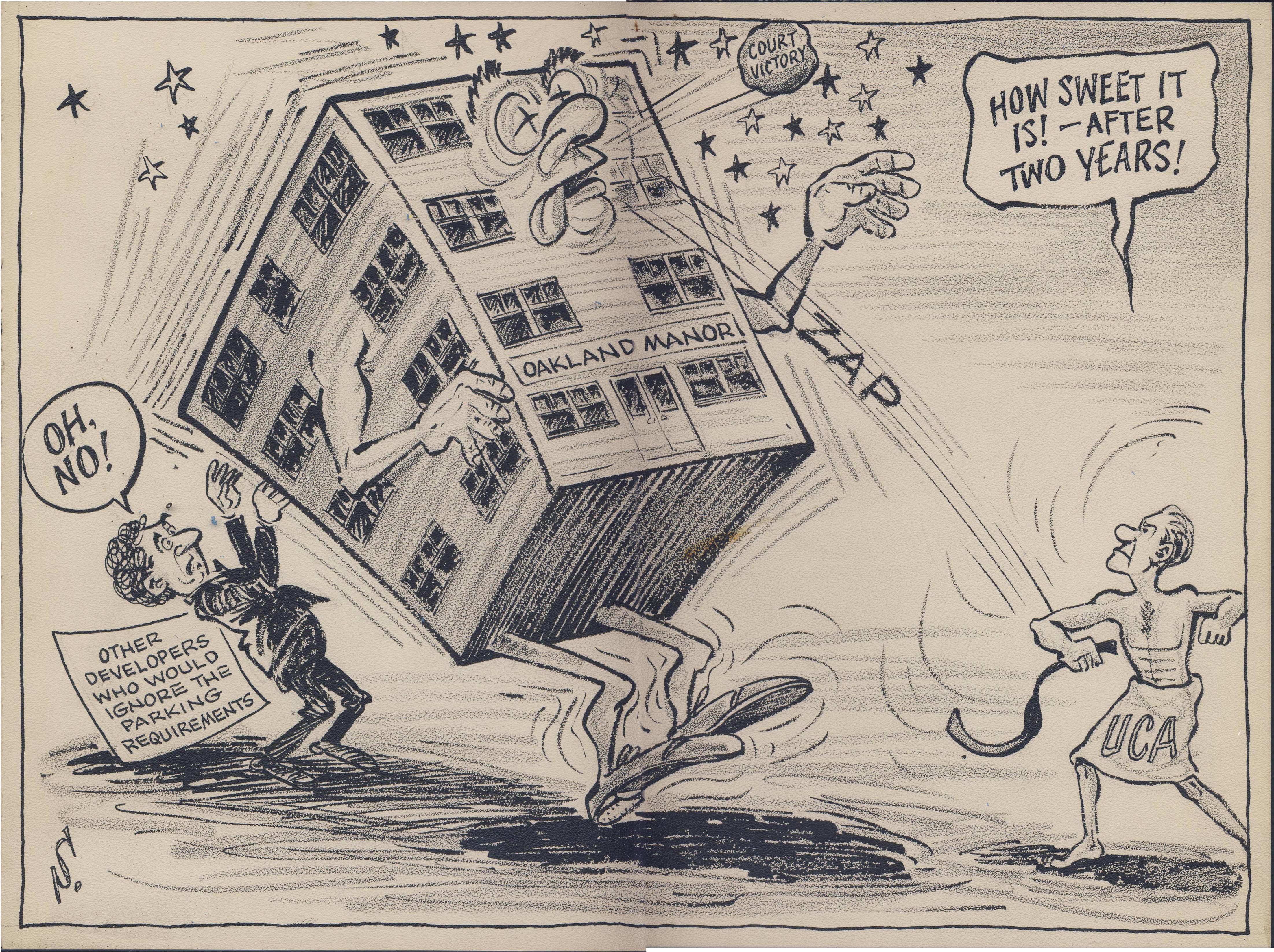
I really have no idea what this issue was all about! It’s an editorial cartoon from The Booster. Back in the late 1960s, Oakland Manor was the name of an apartment complex (with a swimming pool!) at 42-50 West Oakland Ave, 2 blocks north of Lane Ave. between North High and Neil Avenue. Currently I find an “Oakland Manor” on 1871 Oakland Park, in North Linden.

We may not know what the precise issue was, but we can guess that some scofflaw building owner tried to circumvent zoning regulations, and the community was not happy. Back in “the day”, The Booster played a very strong Clintonville advocacy role and this was undoubtedly an example.

[Image courtesy of the Hollenback Collection at the Clintonville Historical Society.]
2020-04-15T16:41:46+00:00April 15, 2020|Categories: 1940-present, Transportation|0 Comments

Gus Grener’s

Gus Grener’s was located at 2189 North High Street (near the corner of North High and Norwich). According to the 1949 city directory, Augustus F. Grener sold “GE refrigerators, Bendix home laundry washers, radios, Sohio products, Willard batteries, and Goodyear tires.” What a marketing concept!

[Image is from the Hollenback Collection of the Clintonville Historical Society.]
2020-03-14T16:41:10+00:00March 14, 2020|Categories: 1940-present, Businesses, People|0 Comments

John’s Drive In

John’s Drive In was located at 3336 Indianola, where Burger King is today. John’s was not listed in the 1950 city directory, but was listed in the 1953 and 1955 directories. By 1956 it had become Beverlee Drive In.

Almost as noteworthy is the telephone booth in front of the restaurant–another relic of the past.

[Image courtesy of the Hollenback Collection at the Clintonville Historical Society.]
2020-01-05T16:40:13+00:00January 5, 2020|Categories: 1940-present, Businesses|1 Comment

Ghosts of Clintonville–Ghostbusted by Google Earth

There are several old residential buildings that have disappeared over the last 12 years–I wish we had photos of them.

The old Hollenback home and The Booster building, located at California and North High Streets. I remember this building setting back over a slight rise from North high Street. This is a Google Earth image from 2004 of the roofs of these buildings.

A large Victorian house demolished to make way for the commercial building presently occupied by Lavash Restaurant. This is the Google image from 2004 of the rooftop.

Another big old residential building, this one located on Weber, one building east from North High Street on the north side of Weber. (Another Google image from 2004.) I’m not sure but believe this building was built for and owned by a member of the Armbruster family, whose patriarch lived in what became Southwick-Good-Fortkamp funeral home. You will find lots of additional information about Mathias Armbruster on my web site.

2019-10-30T11:58:26+00:00October 30, 2019|Categories: 1940-present, Businesses, Houses|0 Comments

Old Piatt Mill

This lovely mill was located on the river, just north of the present Dodridge Street bridge. There is another photo of this, in my book.

The original dam and mill were constructed by David Beers in 1810. Beers owned the land on which the mill was located. Darius Wilcox built a sawmill adjacent to the flour mill. The mills later came to be owned by the John James Piatt family. The buildings burned down on June 13, 1902. The area just to the east and north is where Olentangy Amusement Park was located.

[Image courtesy of Galen Gonser]

2026-02-24T16:39:11+00:00September 30, 2019|Categories: 1800s, 1900-1940, Businesses|Tags: , |1 Comment

E. A. Fuller Farm

The Clintonville Historical Society October 2017 monthly newsletter contained an interesting article about the land at the Clintonville Women’s Club by Mary Rodgers.

________
The Clintonville Woman’s Club: The Women Before the Clubhouse
by Mary Rodgers

I was asked to speak at an evening meeting of the Clintonville Woman’s Club. Specifically, I was asked to speak on the subject of the history of the land that the Clubhouse occupies. I have always understood that the Clubhouse was located on land from the old Fuller Farm. I was surprised to learn more about the “Fuller” family.

In the 1820s, John Rathbone sold farm lot 5 to Edward Amaziah Stanley. Using today’s landmarks, that land would have been bounded on the east by Indianola Avenue, on the west by the river, on the south by roughly Torrence Road and on the north by roughly Overbrook Drive. When Mr. Stanley died in 1862, his land holdings were passed down to his children. Harriet Marie Stanley (aka Hattie) was one of those children. She was born in Connecticut in 1831. Based on the extensive land holdings throughout Ohio, I believe her father Edward was an Ohio land speculator. After acquiring several thousand acres, in 1829, he returned to Connecticut to marry Abagail Talcott Hooker. Sometime between 1831 and 1834, the family moved to the Clintonville area.

In 1856, Hattie married Erskine Asa Fuller, aka E. A. Fuller. E. A. has known as a dealer in stock animals. When her father passed away, Hattie inherited all of farm lot 5 in Clinton Township Ohio. The 1870 census shows a large extended family living together in Clintonville. The Fullers and their daughters, Hattie’s mother, brother, sister and several farm hands and servants. The combined household value per that census was in excess of $25,000. Hattie passed away in 1879. E.A. passed away in 1894. After their deaths, the farm was transferred equally to the four Fuller daughters–Abby, Mary, Katherine and Martha. Martha Fuller and her sister Katherine Fuller Peters lived all of their lives in Clintonville. They owned two brick homes along High Street; Katherine’s was just south of where the Library sits today and Martha’s was where the Christian Science church sits today. Martha Fuller passed away in 1938. She left half of her land holdings to long time farm hand Matthew McCallen and half to her niece (sister Mary’s daughter) Helen Osborn. Eventually, all the land was sold off, some to the Christian Science Church, and some to the Calvary Bible Church and the balance to the City of Columbus. The lane where the Clintonville Woman’s Club land is located was purchased by the Kiwanis Club of Northern Columbus. That Club loaned the ladies the funds needed to build the Clubhouse. In turn, they held a mortgage on the property. The Woman’s Club members worked tirelessly and retire their debt to the Kiwanis within five short years! They have owned the Club house and property ever since.

Go to Top